We see her set up her stand with a determined gesture: she places on a sanded floor some boxes in which we can guess are sheets and pictures assembling a table that must reach two meters in length. With a whitish tablecloth she covers the surface of what will be, throughout this sultry summer afternoon, the display where she will present her work. Her gestures are those of someone who is taking her first steps in the art markets. Agile movements that do not prevent her from greeting her companions while they also arrange their counters. Today the enclave is Sa Rapita, in a few days the thumbtack will be nailed in the latitudes of Pollença. Next week it will be Puigpunyent's turn. Peti Collage could be considered a nomad. It has been nine months since she took up residence in Mallorca, but her work makes her a wandering artist who carries her gear with her. The sun begins to set behind the lighthouse of s'Estalella, but it still stings. The artists take shelter under a wooden structure that the organization has provided for this purpose, one for each project. From time to time, gusts of air bring with them a salty aroma.
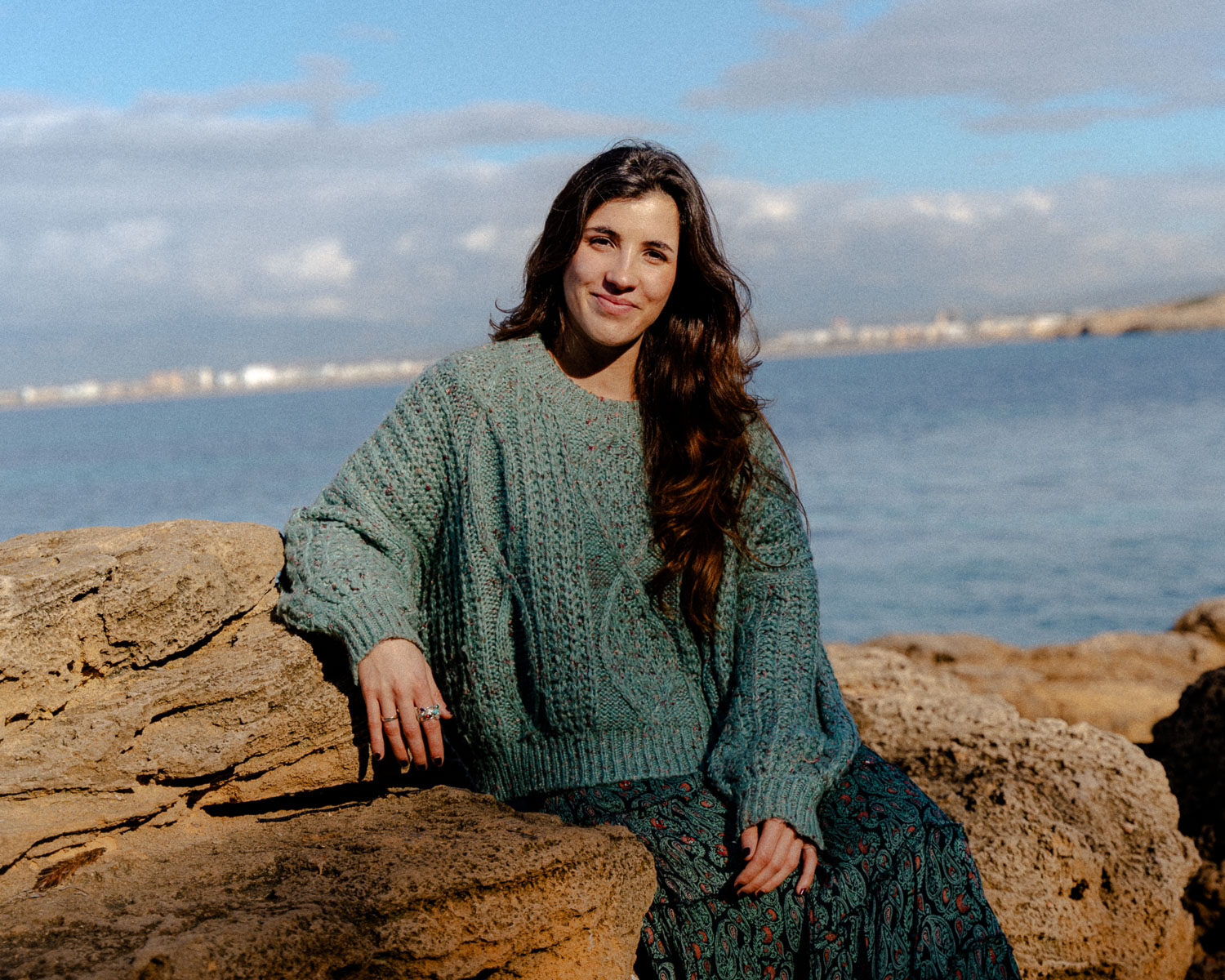
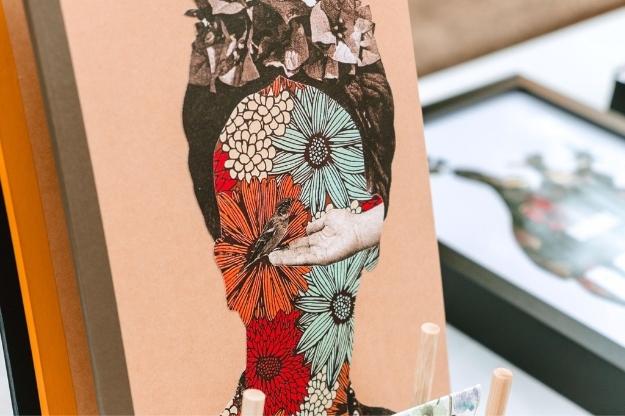
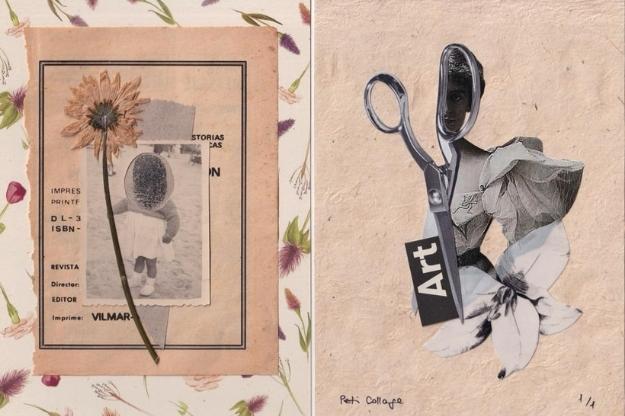
We approach her as the market atmosphere takes on a festive air. Girls with pigtails on their parents' shoulders, foreigners licking pistachio ice cream, twenty somethings lifting a bottle of beer to their lips. The tunes proposed by the DJ rise above the crowd and the heat offers us a respite. Julia Petisco is categorical when she explains the reason for her work. "I had been working as an employee for a few years and I decided to leave that path. When I was a bit alone and with myself, collage found me". She stops her explanation and leaves us wanting more; some customers have just arrived at her stall with curious expressions. They observe her work without losing detail: sheets that tell stories about a woman's body pierced by a flower, about a couple dancing in a cup of coffee, about a feminine face flooded by a transparent sea. This is the imagination of Peti Collage, her art project. "I was looking for a gap to know who I am. I was trying to fill my time and clear my mind with a therapeutic purpose."
Julia had always harbored an enormous interest in art in all its forms, a sensitivity as apectator that led her to seek inspiration wherever her eyes rested, which have drunk from many sources. Then her head pushed her to launch herself into the unknown, a leap that is usually met with the occasional hint of vertigo. But not in her case. "Collage is quite democratic if you want to get started in it. At its core, it's all about cutting and pasting. So, at no time did I feel that barrier of fear when it came to tackling its technique."
"My father was a ceramics teacher, and I always remember him with his hands in the
clay".
Julia was born in Asturias. She lived in Ribadesella until she was seventeen years old, a secluded place bathed by two waters: the meekness of the Sella River and the fierceness of the Cantabrian Sea. The height of its mountains protects its inhabitants and paints the landscape with a green color irrigated by the rains. A month before her coming of age, she packed a couple of suitcases and went to Madrid to study Audiovisual Communication. The capital made a deep impression on her from the moment she set foot on its sidewalks. She never ceased to appreciate the architecture of its buildings: the stately facades, the curvature of its cornices. "I have acquired part of my inspiration from the exhibitions I went to. A lot of cinema, a lot of photography, a lot of design. In Madrid I had a lot of activities to draw from.
It was the city that shaped her as an artist and as an adult. Her work has always been associated with the cultural industry. After working for four years in the audiovisual distribution of film festivals, she decided that her career had to take a turn. A turn of one hundred and eighty degrees that could be connected to her father's talent. Her features turn melancholic when she evokes him. "My father was a ceramics teacher, and I always remember him with his hands in the clay. In our house he had a small studio and in the high school where he taught he had a workshop with a potter's wheel and a kiln. I come from a family that practices craftsmanship. My uncle carves in bone, my aunt sews and upholsters and some of my father's cousins are painters. When you want to discover yourself, that's a seed that's planted there". And we all know that every seed has to be constantly watered.
"This is not just a creative challenge; it's a commitment to the environment".
That irrigation has been her effort, which in its beginnings had a point of exploration and play. She tried with scissors, with the cutter, with the scalpel. An experimentation that managed todefine her style when some causes crossed Julia's path. These are the most hot topical themes that spur her, at all times prolific creativity, as she has never stopped creating. Peti Collage's work is full of designs that denounce machismo, that underline the nuances of interpersonal relationships, that vindicate her concern for climate change. All peppered with biting humor. In fact, that consternation for the direction the planet is taking is not only present in her designs; it is a constituent part of a purely analogical process. "I go down the street and look at what has been thrown away in case I find any material that has potential for my work. Magazines and catalogs that are sometimes of quality. When your environment starts to find out what you're looking for, it also gives you things. I try to give a second life to something that would end up discarded. This is not only a creative challenge; it is a commitment to the environment".
Since she landed in Mallorca less than a year ago, Julia has found another kind of inspiration on the island. A calmer tempo in the comings and goings of people, another palette of colors on the Balearic coast. Her collages can be purchased at different points of sale such as the Just Sant Elm store, Botons Palma and the Salina bookshop. The designs she creates in her home studio are not usually exhibited in galleries, as if collage had no place on their walls. "They are very hierarchical and the conception they have of art is somewhat old. Painting above all else. Canvas and brush. It's true that something is changing because collage is gaining presence, but they still have a bit of an archaic mentality about what should be exhibited in a gallery." Peti Collage has presented her work in a wide range of spaces, those that make up a more underground circuit: numerous bars where she has shone as an individual and other group exhibitions such as those at Matadero Madrid. The culmination of her career, however, was at the Ateneo de Málaga, where her work Identidades notables occupied the Frank Rebajes room.
The day begins to say goodbye to the festivities of Sa Ràpita. Julia Petisco looks at the sky and thinks about the present, in the exhibition that can be enjoyed until the end of September at La Mujer de Verde, a vegan restaurant located in the center of Palma. But she also looks to the near future: to her website, which is in full development, to her online store where she will be able to offer her creations, to the visual identity of her brand, which she will renew with a graphic designer who is a friend of hers. "I limp a bit in those things because I'm not a digital native, that's why I like working with my hands so much." Immediately afterwards, a concert of fireworks resounds in the night.