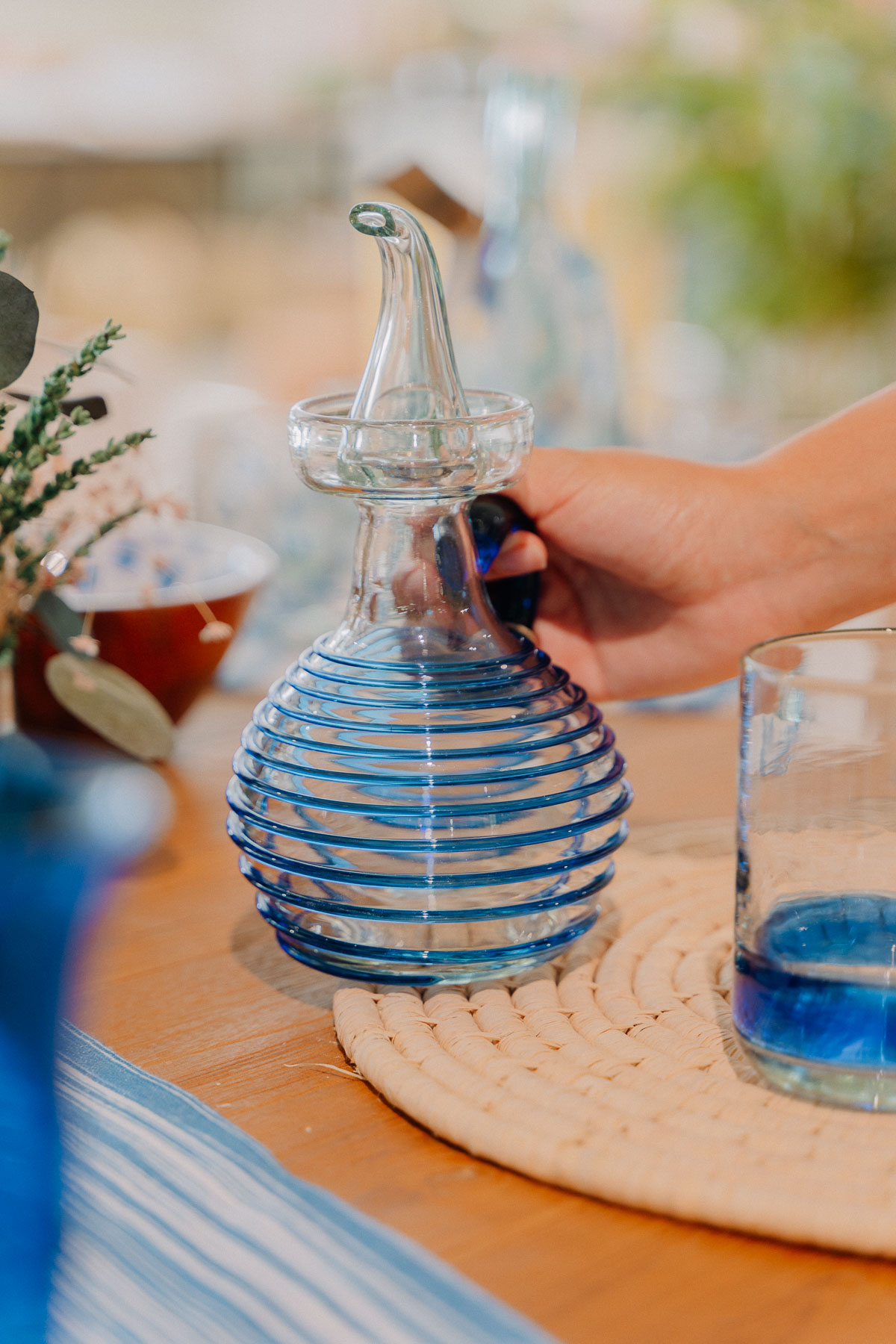
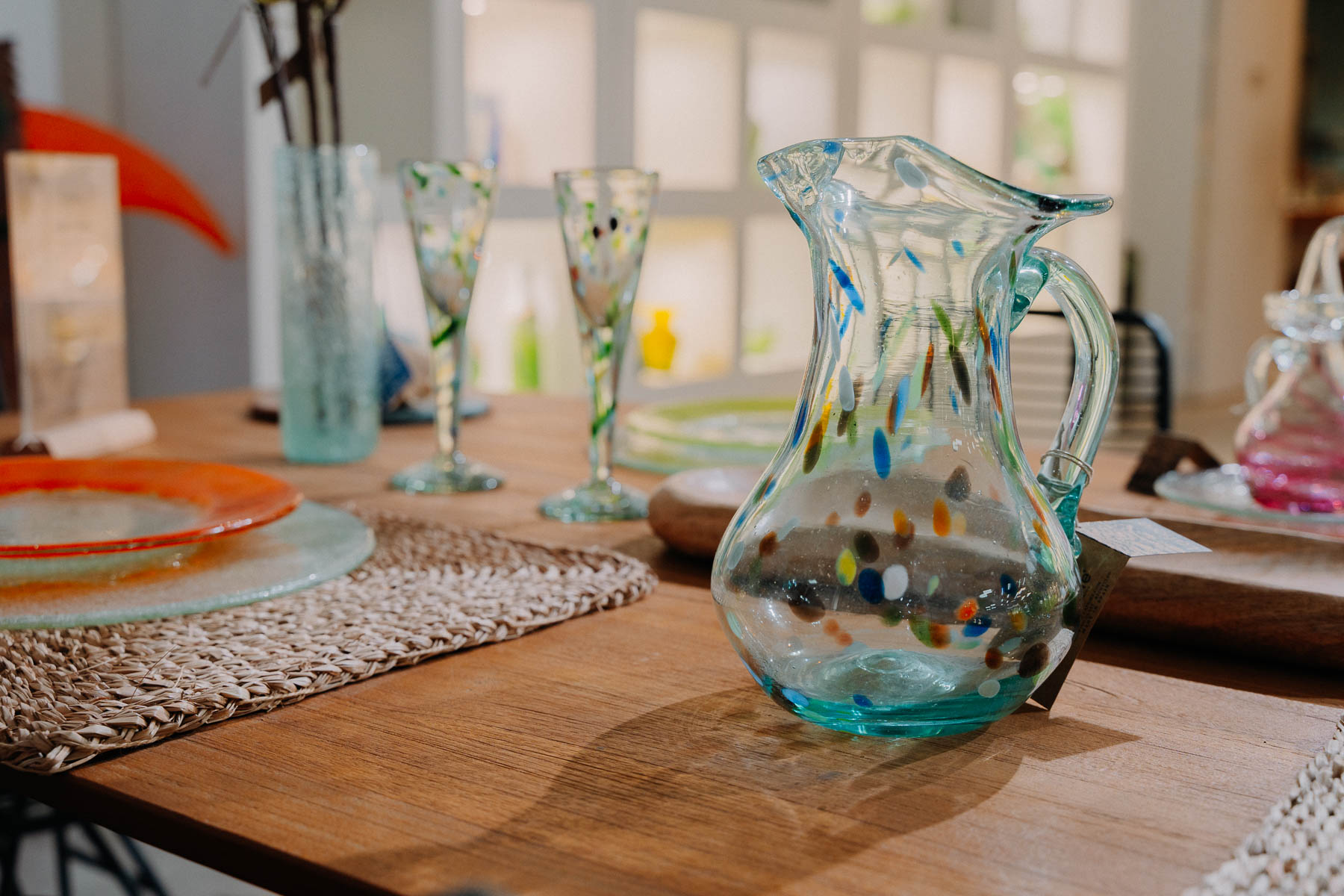
With the technique of the master craftsman and the precision that only comes from experience, Lafiore transforms discarded glass into durable, unique and pricelessly beautiful objects. It is not magic. It is an inherited tradition that was born in Murano and that the Tortella family turned, six decades ago, into a way of life.
In this historic factory in S’Esgleieta, masters and assistants work in perfect harmony to shape each piece as if they were dancing a waltz. Both 'have to be absolutely synchronized. Each one has a function at all times and if either of them fails to do their part, the piece can lose temperature and has to be discarded'.
Sonia, project manager of the Mallorcan factory and promoter of collaborations that make Lafiore more current than ever, is in charge of explaining everything with simplicity but with passion and admiration.
Despite the passage of time and the changing pace of fashions, Lafiore has been able to keep up to date: the designs and colors of production have diversified, aware that 'changing and adapting to tastes in decoration and design, being up to date and offering more products aligned with demand' is vital for the survival of any craftsmanship.
'We are fortunate to be continuously contacted by many local companies with projects that are compatible with ours, and it's a great luxury because we all learn.'
Unable to calculate how many pieces make up a catalog that is being nurtured based on tests and new ideas, Lafiore continues to manufacture conventional products in series, but has also established itself through small collections that are the result of collaboration with local designers, such as Nico Guevara, and companies on the island in the hospitality sector in a constant dialogue between tradition and innovation. We are fortunate that many local companies regularly contact us with projects compatible with ours and it is a gift because we all learn'.
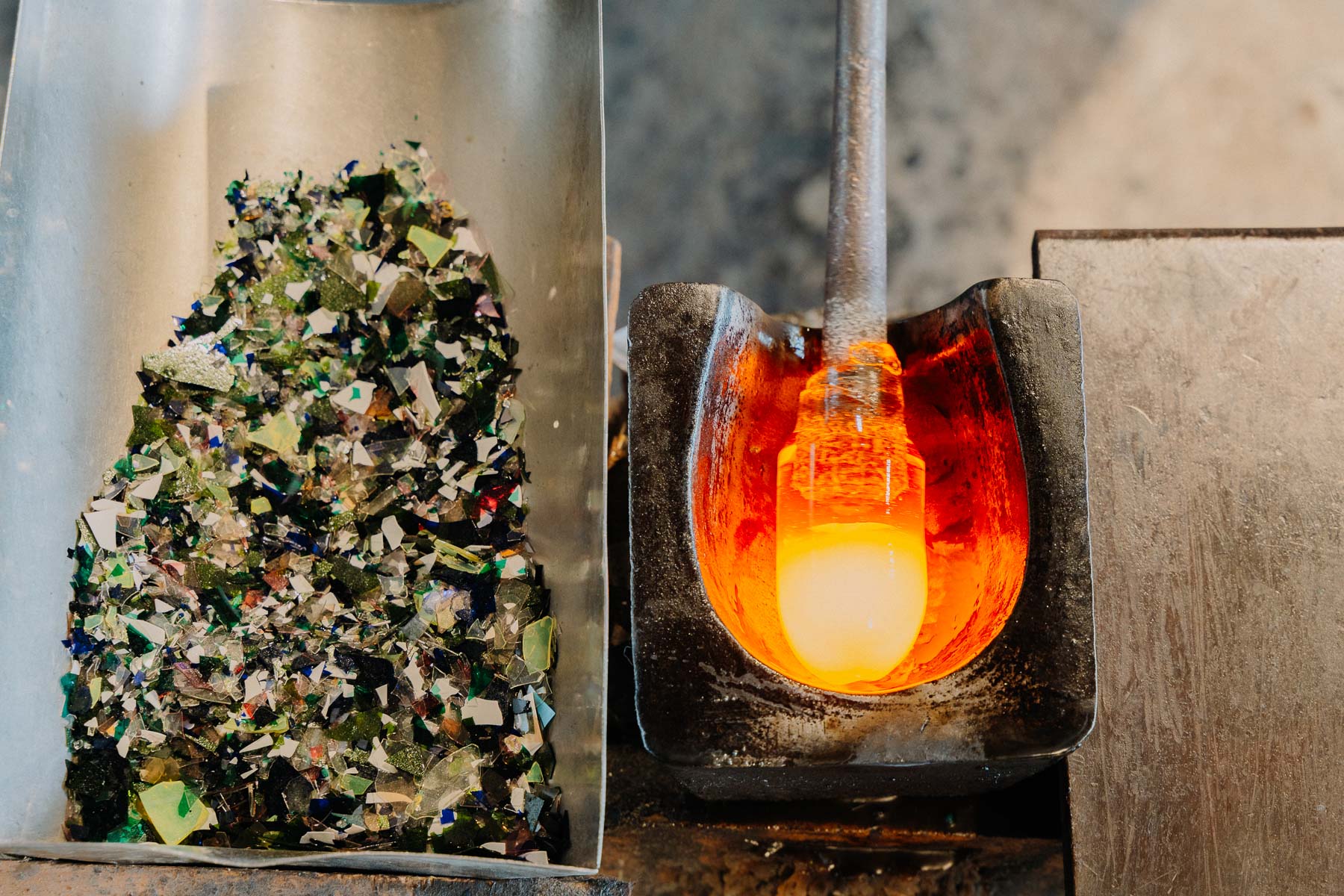
Sustainability is not trivial in a factory like this. We have always used recycled glass as raw material: from glassworks in Mallorca and, from last year, we collect non-returnable glass bottles from Playa de Palma, where there is a lot of hotel density'. In addition, thanks to the installation of plates, in summer they are self-sufficient and have subjected their packaging to a process of involution -in the most positive sense of the word-: 'now we wrap the pieces with newspapers, as it was done in the 60s. Back then there was no plastic balls'.
When the collected glass arrives at the factory, it is chopped and melted at 1200 degrees Celsius. With the foot, the master opens the furnace and takes out the glass with a cane. The amount? An unknown quantity for the rest of us mortals. It is essential to know how much glass to take and the only way to know is experience,' says Sonia. Once extracted, there is no time to waste. It is 'a fight against the clock because when it starts losing temperature, you cannot moderate it'.
Thus, five blown glass artisans and a glass fusing artisan work with pinpoint accuracy to bring new pieces to a market difficult to catalog. There is no customer profile: local and foreign; by the web, in the store or in retail outlets; men and women ... we produce a highly prized product'.
'He always wants to move forward, to innovate, to take on new challenges. Lafiore is like that'.
That this historic industry was declared an Intangible Asset of Humanity in 2023 is no coincidence, says Sonia. It is, rather, 'the recognition of an ancestral technique rooted in Mallorca' which Miquel Tortella -third generation of the family and manager of Lafiore today- has improved since he was a child and for which he has driven 'a natural evolution'. ‘He always wants to move forward, to innovate, to take on new challenges. Lafiore is like that'.
Thanks to this change -decided, conscious and respectful-, Lafiore has strengthened ties with other crafts in the island -such as Teixits Riera- and projects as special as the restaurant Ca na Toneta, for whom they have created a collection of glasses ad hoc. But the challenges that the factory gladly takes on do not end here.
One of the most recent challenges - and successfully inaugurated - is its coworking, Sa Peixera, a multipurpose space located in the old warehouse that was born of a strong commitment to art, design and innovation, and hosts different disciplines and exhibitions of resident artists in an agenda open to the public that is completed with workshops and monographic ceramic courses, guided tours and its latest bet, Tardeart: a kind of tardeo that combines workshops, experiences of lathe, music and lots of conversation 'in a fantastic atmosphere'.
With an energy that, like glass, is transformed, molded while expands, the future of Lafiore is a sea of exciting challenges in which, in fact, they are already working hard for: strengtheningits initiative to collect and reuse glass Som Circulars, innovate -even more- in design and calculate the carbon footprint generated by its production to know what Lafiore means for the environment mark its immediate path. Meanwhile, in the factory, new objects take shape and consistency in a hypnotic craft exercise that makes our homes more beautiful places and this craft a really enduring tradition.