A few weeks ago we had the pleasure of sitting down with Elena Zafón, the head of Biznaga Atelier. Elena is a fervent admirer of what Steve Wonder called, in one of his albums, The Secret Life of Plants. That lunchtime we spent with her touched on different interesting topics, but the most valuable pearl we took home has to do with what she said about the society that humans weave, irremediably, with nature. We are attracted to it, Elena suggested.
It is precisely that attraction, the influence that mother earth exerts on us, that now works as a link to talk about a project that takes place outdoors, in a wild environment and paying tribute to the Mallorcan landscape: The Glamping. Nahuel Signetto is kind enough to make time for us to explain how his initiative, launched with his partner Antonella Kuni, has become a success that is repeated every season. "When we arrived here eight years ago, we realized the enormous potential that Mallorca has in terms of nature and culture. It is an island with a lot of history to tell and few storytellers, although there are more and more of them every time". Arriving from Argentina and captivated by the vibrations emitted by the island, the members of The Glamping can be considered as the narrators of this story. Their story is transmitted in a contemplative way after camping in the middle of bucolic landscapes. A rural experience that lasts a few nights and that connects us to the most primal: to watch the birds nesting in the trees, to walk the forest trails, to enjoy a sunset before the crickets sing. "All this history used to be covered by the noise of the masses, alcohol and cheapness". That's how Nahuel sees it, and we agree with him.
The Glamping team has always been sensitive to the damage that unregulated tourism, which has been practiced in the Balearic Islands for decades, can cause to nature. We are facing one of the main sources of wealth globally; the reasons for this outrage, as always, are economic. That's where The Glamping comes from. "It was born as an alternative for the public that is looking for something else. When different proposals appear, the client changes their way of thinking and evaluates their way of consumption". After Mallorca presented them with its capabilities, they forged an idea that fled from the prostitution to which the island is subjected because of lobbies, political decisions and big business: a kind of tourism that respects biodiversity and connects with oneself. "We come from the world of events, and we immediately detected a lack of projects made with soul and essence. That's why we wanted to create a long-term sustainable offer, much more responsible and fully conscious."
"We like fire, cooking with wood, the smell of wet earth and walks in the woods".
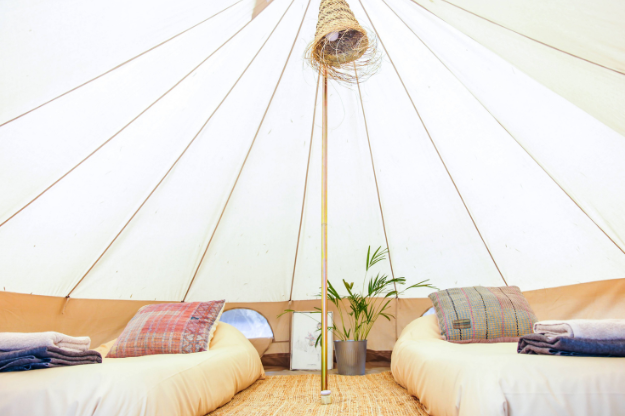
The Glamping's ways bring together several elements that are indispensable for its development. Those who lead the project must find people willing to spend the night in wild areas, set up a camp surrounded by vegetation and provide one of its main attractions: tents. "We have tents sized four and five meters in diameter. The material they are made of is organic cotton. They protect from heat and cold. The sleeping mattresses are viscoelastic". All a privilege to feel the luxury of spending the night in almost secret places that are distributed by the Monestir de Miramar, a centenary oak grove next to Inca or its next enclave, located somewhere near Cala Falcó. According to Nahuel, what they have done has been to extrapolate their concerns, those that belong to their private life, to the project. "We are looking for a simple, country life. We like the fire, cooking with firewood, the smell of wet earth and walks in the woods". And at The Glamping you can find all that and much more.
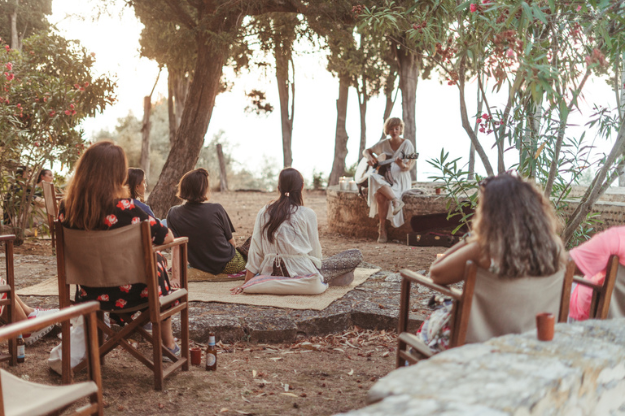
During the exclusive experiences they offer - they last no more than three nights - the client can enjoy different activities, and all of them connect with something: the earth, gastronomy, constellations or even our own being. They define themselves as a pop-up events company; they are nothing like a conventional tourism company. They personalize the content of their offer considering the priorities of the people who resort to their services. "We don't cater to individuals, but to groups. We organize yoga retreats with Sadhana Works, we have an astronomer who brings his telescope to observe the stars, Tomeu Arbona participates with us in gastronomic archeology, Deborah Piña has collaborated with the project almost from the beginning and we also work with Althea (Nom Nom Craft Bakery) in the breakfasts". As we can see, The Glamping opens its arms to anyone who adds value. That's why they also include African dance and live music in their experiences.
The Glamping is dedicated to launching packages with all these offers on specific dates. The public, little by little, is filling the quota of these experiences. "People can sign up individually to a group that we form, with a maximum of twenty people. But there are also couples who come together, even with their children. These people sleep in the tent of their choice." Lunches and dinners are moments of sharing. That's why the table where the banquets are served is long, with no room for separation, so that the participants, even if they don't know each other, can experience this moment of communion with others. On the other hand, the staff of The Glamping has its own kitchen team, which prepares recipes with a vegan conscience. When they do not have the collaboration of another catering professional, they themselves buy the raw materials for their culinary creations. The origin of the product, in this sense, is guaranteed.
"Since we founded this project, the world has changed. People are more concerned about consuming in an environmentally friendly way".
One of the keys to the project is undoubtedly its mobile nature. The Glamping camp is transportable, which means that it has no fixed headquarters. Although they have some geographical preferences that we have already mentioned, they move around different areas of the island so as not to harm the life cycle of the ecosystem. This is their Nomadic Camp format, which leaves no footprint on the environment. The negative impact is zero. "Anyone can rent our tents to stay with friends wherever they want. If someone wants to do a yoga retreat or celebrate a birthday on a private estate in the middle of the mountains, they hire The Glamping. Then we set up the infrastructure of a nomadic hotel." Its luxury tents, made in Belgium, are not the only equipment available to this hotel: a trailer with some handcrafted showers, with views outside to contemplate the sky and the trees, represent another of its comforts. Each tent cannot house its own shower because "it would not be sustainable," Nahuel expresses firmly.
The project's flexibility has created a range of different products for different targets. If the foreigner who comes to Mallorca with a series of activities already set up - disco, sun and beach - enjoys an experience with The Glamping, at least they will return to their country with a different image of the island. They will know what natural heritage this land contains. Somehow, the project created by Nahuel and Antonella will inoculate in the consumer's head a new, but ancestral idea: the return to the countryside. "Since we founded this project, the world has changed. People are more concerned about consuming in an ecological, more local way. There are more and more vegans, not just for health reasons, but out of respect for others. The project, therefore, is aligned with what the world offers today". When we ask Nahuel if he is optimistic about the future, he does not hesitate: "totally".