The ascent to the Serra de Tramuntana is an immersion into another era, a journey of just twenty kilometers in which the landscape of Palma becomes a wooden postcard. The car glides along a road that is full of turns until Valldemossa is discovered in the middle of a valley. The bell tower of the church stands out among the rest of the houses, and the tower of homage of the Carthusian monastery disputes the heights to be closer to the sky. The valley where the village sits is filled with a strictly Mediterranean flora, with a tree that has been well acclimatized to this soil since immemorial times: the olive tree. This is what Bárbara Iten explains to us when we arrive at the domains of Son Moragues, the organic farm that we visit today and that encloses an important part of the history of Mallorca. The trees that look at us from all sides could well tell it. "If you begin to see these olive trees as if they were creatures, as if they were human beings, you will have a better idea of the place that surrounds us". Barbara asks us to open our eyes, to breathe in, to take in the nuances of our surroundings.
We are in a setting of breathtaking beauty. We follow a path that crosses an olive grove with more than ten thousand specimens, all of them centenarians. While we let ourselves be enchanted by this exhibition of nature, Barbara enlivens the walk with some comments that give the visit a touch of legend. She is aware of the importance of the territory we are walking on, a Tramuntana shaped by the dry stone terraces that protect its slopes. "During the Reconquest, James the I not only saw Mallorca as a beautiful island. He also knew how to recognize its strategic potential in a risky time for trade, especially due to piracy. In addition, he quickly realized the fertility of this land". In the mountains the most intrinsic tree species of the Mediterranean grow, which are pine, oak and olive trees. The latter is the reason that made us visit Son Moragues, a possessió that produces a completely organic extra virgin olive oil that we plan to taste. Although it is true that in the thirteenth century, oil was as valuable as gold for reasons totally unrelated to our diet. Barbara tells us: "Oil meant light. At that time, every house had at least one oil lamp".
"In Son Moragues they use neither pesticides nor fertilizers; the field looks as it would have had centuries ago".
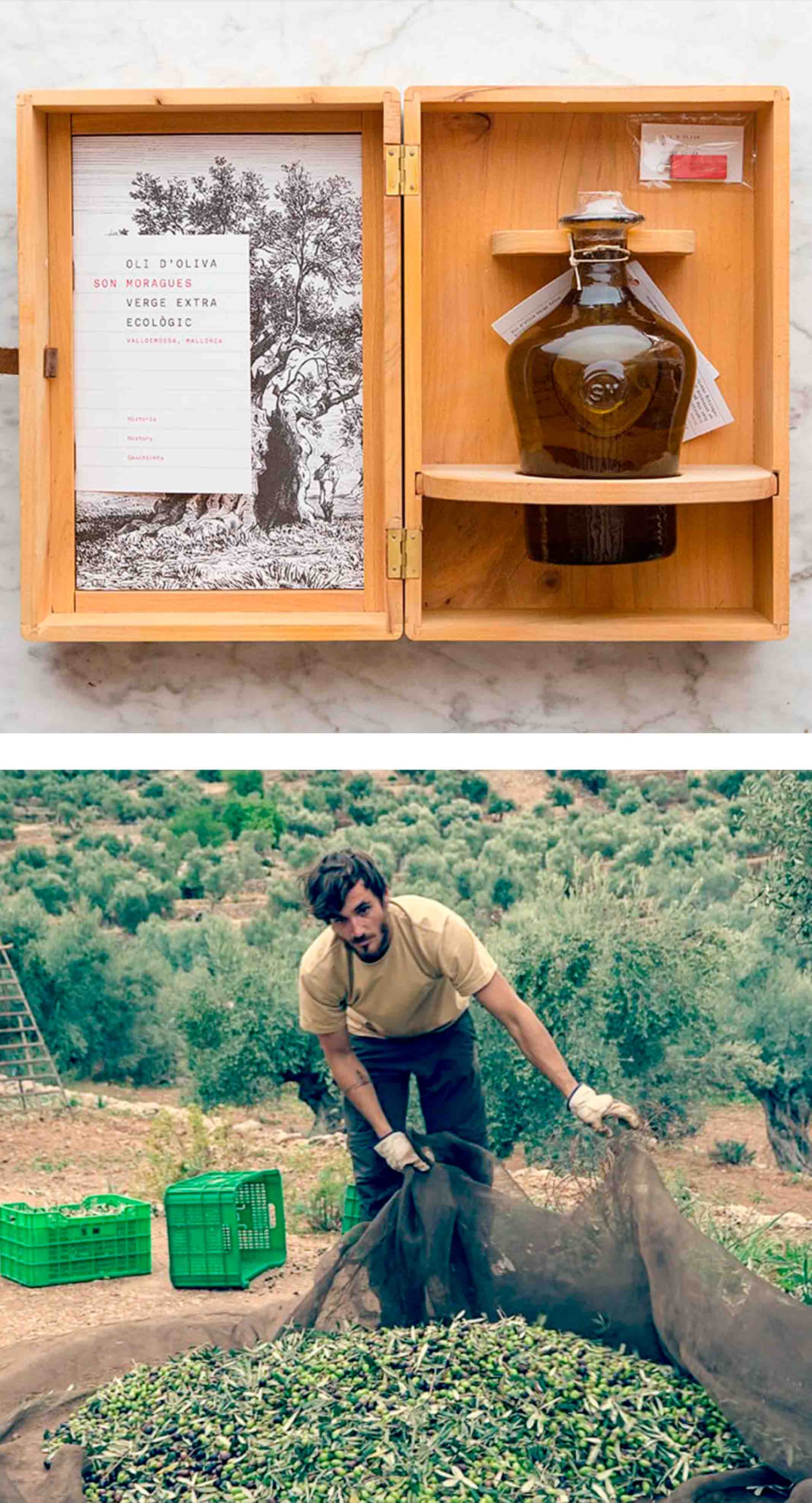
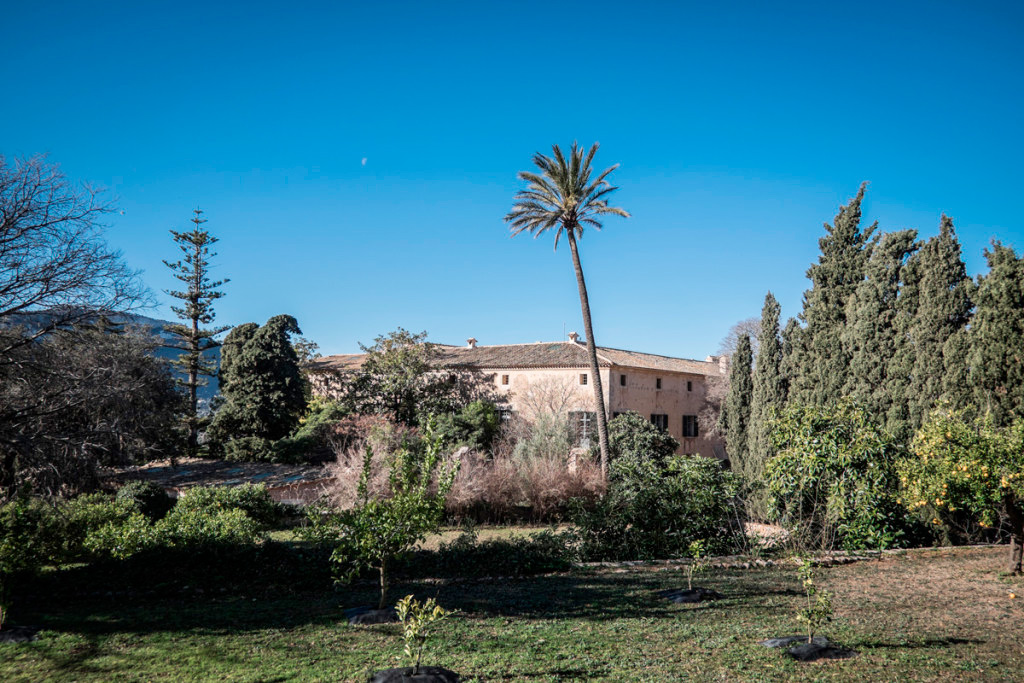
All these conditions we have just mentioned, which are not few, made Mallorca the ideal location for the commercialization of such a precious product. We received all this history lesson under the foliage of an olive tree, one of the longest-lived of those that inhabit the hundred hectares of Son Moragues. According to Barbara, it may be two hundred years old. James I, then, outlined a perfect business plan to enrich himself at the expense of oil: he arrived on the island, got rid of everything that was not olive trees and began to try grafting wild olive trees onto the Mallorcan variety that produced larger olives. The result of this experiment is the panorama that stretches out before us. "At the moment, Son Moragues is in the hands of a private individual. A person who wanted to restore this olive grove back to the state it was in between the 13th and 18th centuries''. A transformation that began in 2006, a process full of sacrifices and work so that today, seventeen years later, they are proud to practice organic agriculture. In Son Moragues they use neither pesticides nor fertilizers; the field has the same aspect that it would have had centuries ago.
We climb up the slope of the olive grove and find some traces of sheep manure. "This is the only fertilizer we use for our trees," Barbara assures us without slowing down. A natural recipe that strengthens the olive trees of Son Moragues, which need to produce eighty kilos of olives for each liter of oil. The trees that parade before our eyes would not look so imposing if it were not for the terraces where they rest, those dry stone walls that retain water when it rains. Thus the olive trees, through their roots, absorb it to their fill. In 2006, most of these walls had crumbled with the passage of time. The terrain was impracticable. "Restoring the walls was one of the most expensive tasks of the entire project. It is a world heritage site, and not everyone has that knowledge in Mallorca. On the island, this engineering work is considered an art". Fortunately, they found a work team from Morocco, where they are used to working with these materials, who reconstructed a good part of the terraces that are now back on their feet. The work lasted until 2016, a titanic task that took them ten years.
In the past, it was the donkeys who knew these paths by heart, and they themselves could load the olives in their saddlebags to reach, without anyone's help, to the Son Moragues oil mill. An oil mill that is now in disuse because there is an idea that will be implemented during this year. "Together with other farms in the Serra de Tramuntana, we are going to set up an organic oil project managed by the Sóller Cooperative. There we will have an expert tafoner, each farm will have its own tank and we won't have to depend on anyone". Barbara tells us that, at present, there are many restrictions related to any plan to be implemented in this area of Mallorca, considered a World Heritage Site. Any move must be made with the utmost responsibility, and transparency is of paramount importance in any development. "We want to be an example and we open the doors to anyone who wants to know what we do".
"We are not only dedicated to producing oil here".
The Son Moragues estate is part of Tramuntana XXI, an association that rows for the conservation of the values of the mountain range. For the time being, this collective has managed to get the owners of different estates to pool their efforts to try to find, as far as possible, economic ways to move away from hotel exploitation. "We all agree that this has to be protected". To protect means, among many other things, to carry out the tasks they do in Son Moragues: harvesting by hand and natural fertilizing. Techniques that depend, to a large extent, on the whims of nature. Some years the production has reached an impressive amount of eighteen thousand liters of oil; others, on the other hand, have only managed to bottle one thousand two hundred. In spite of these figures, in Son Moragues they believe in their way of doing things, artisan and manual, because it paves the way to the future. Their work is an act of love. This is a restoration project that promotes sustainability.
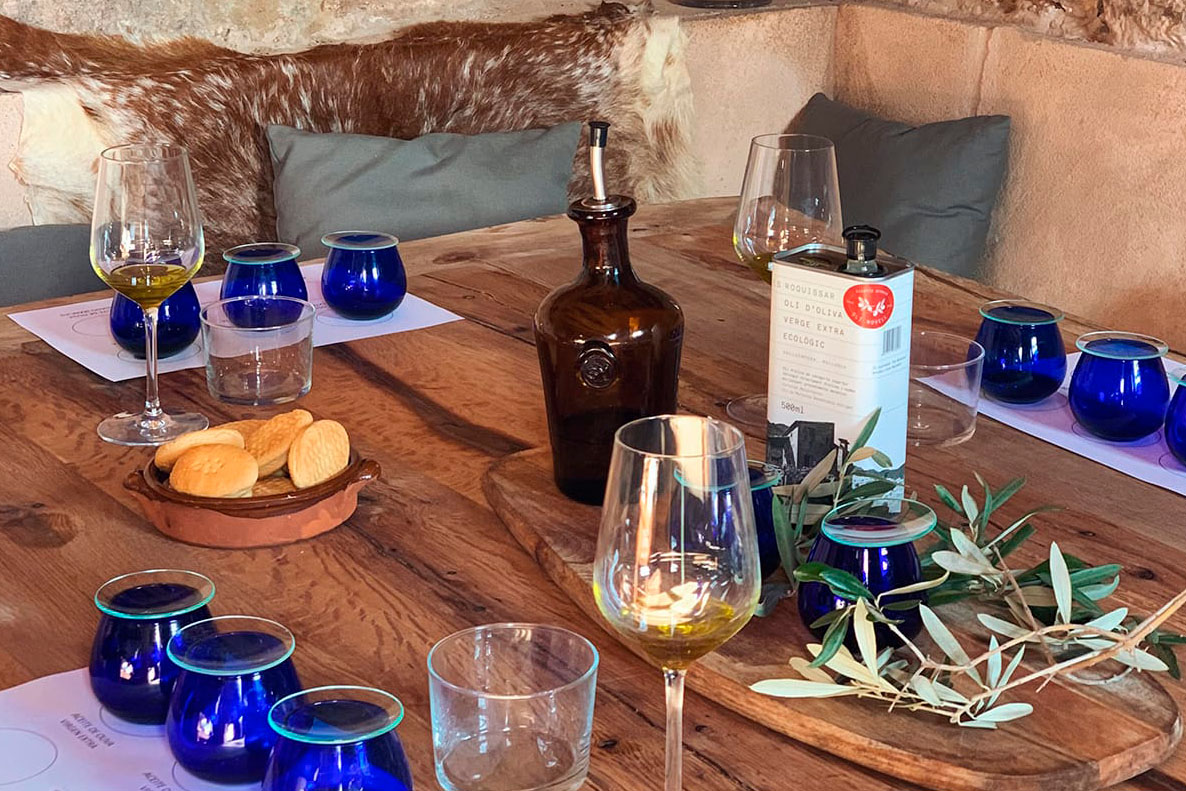
"Here we are not only dedicated to producing oil". Barbara communicates this reality to us sitting around a low table, outdoors, next to a farmhouse open to the four winds. The construction dates back to 2007, but it was built according to the wishes of Archduke Lluís Salvador of Austria, one of the inhabitants of Son Moragues. A man ahead of his time. It is a small Mallorcan country house, made of traditional architecture, whose style invites you to enjoy the country snack that Barbara has arranged before us. Four types of jams, a bowl with olives and glasses with a finger of oil. A still life of products that can be purchased in many points of sale scattered around Mallorca, such as Uco Bakery, Ecoilla, Mallorcària or Cocos Garden. Some of them reach London thanks to Selfridges. The others can be purchased at the Son Moragues store in the center of Valldemossa. We are going to be left with the desire to taste the Es Roquissar gin that Stefan Winterling, from Gin Eva, elaborated with botanical ingredients from the estate. However, we tasted an oil of the same name, bottled with the glass-blowing technique practiced at Gordiola. One sip is enough to understand the journey we have just experienced at Son Moragues.