 Gastronomy
Gastronomy
Read moreYumee. Where Cuisines Meet
Mark as favorite
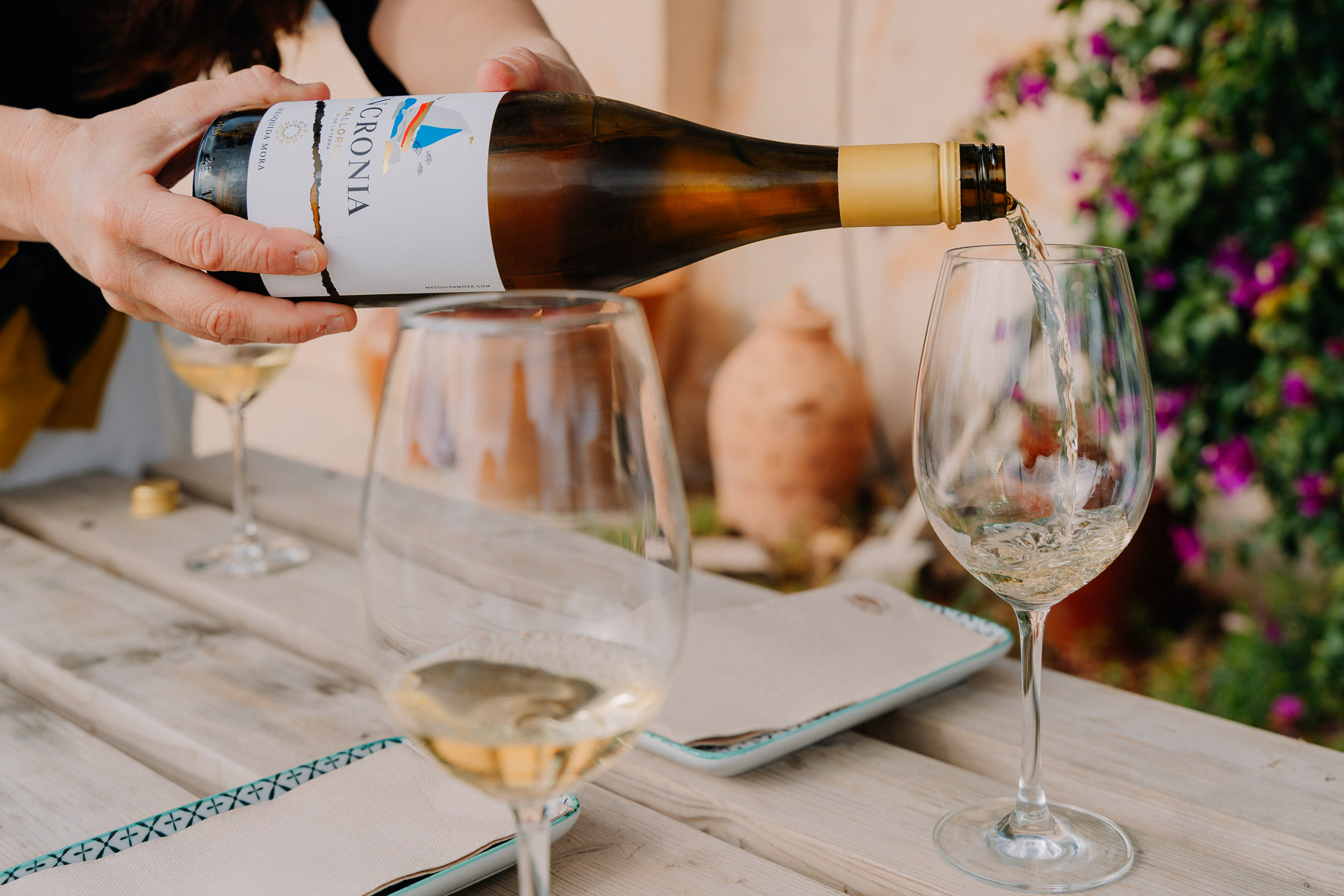
The tasting is the highlight of our visit. As it is a beautiful day, we will do it outside, on a wooden table that uses a vine as an umbrella, to be sheltered from the sun.


Author: Cristian Rodríguez Domínguez
Photographer: Jaume Oliver
Welcome to a journey of the senses through the world of the vine, where each glass is a portal to the richness of aromas, flavors and experiences that only wine can offer. In the charming enclave of Porreres, we immerse ourselves in a tasting that transcends the ordinary, exploring the diversity and winemaking excellence that this region has to offer.
We begin this experience on a sunny morning in February, when we park the car in the celler's parking lot. We are soon welcomed by Bàrbara, alma mater of the winery, who will be our guide and reveal all the secrets of this project so deeply rooted in the territory. The starting point of our visit is the circular vegetable garden for self-consumption, where we immerse ourselves in the rich history of the family project that goes back four generations, to 1945, when her great-grandfather started making wine and planting apricots, a tradition rooted in Porreres.
But the Mesquida Mora project was born in 2012 as a turning point, a new opportunity for her to continue the winemaking legacy. Bárbara tells us how, without a place to locate the winery, but with a deep connection to the land, she decided to embark on this adventure with her brother to give a new push to this company. She finally would find the space, an old cowshed that had belonged to the family for some time.
We continue with the tour, which takes us through the vineyards, where the monastrell variety (abundant in the Mediterranean) is the predominant one, but there is also some of the other variety planted, callet. Both are carefully cultivated following sustainable practices. Here we learn about the goblet planting system, which prioritizes quality over quantity, and is a method that requires less water, a resource that is becoming increasingly scarce. Another technique that is used is the planting of vegetable covers, which can be seen between the rows of vines and help to avoid the use of pesticides.
We are now headed to the main building, where the winery is located. The space is not very big, but the idea was that it would be something quick to set up, to get going as soon as possible. The space is made up of eight aluminum tanks and one wooden tank, where the wine is deposited once it has been processed. In the background, what remains of the original cowshed, are Carlos and Sebastián, who at that moment were pumping wine from the tanks into smaller wooden barrels, because they are preparing the coupage of Sincronía tinto.
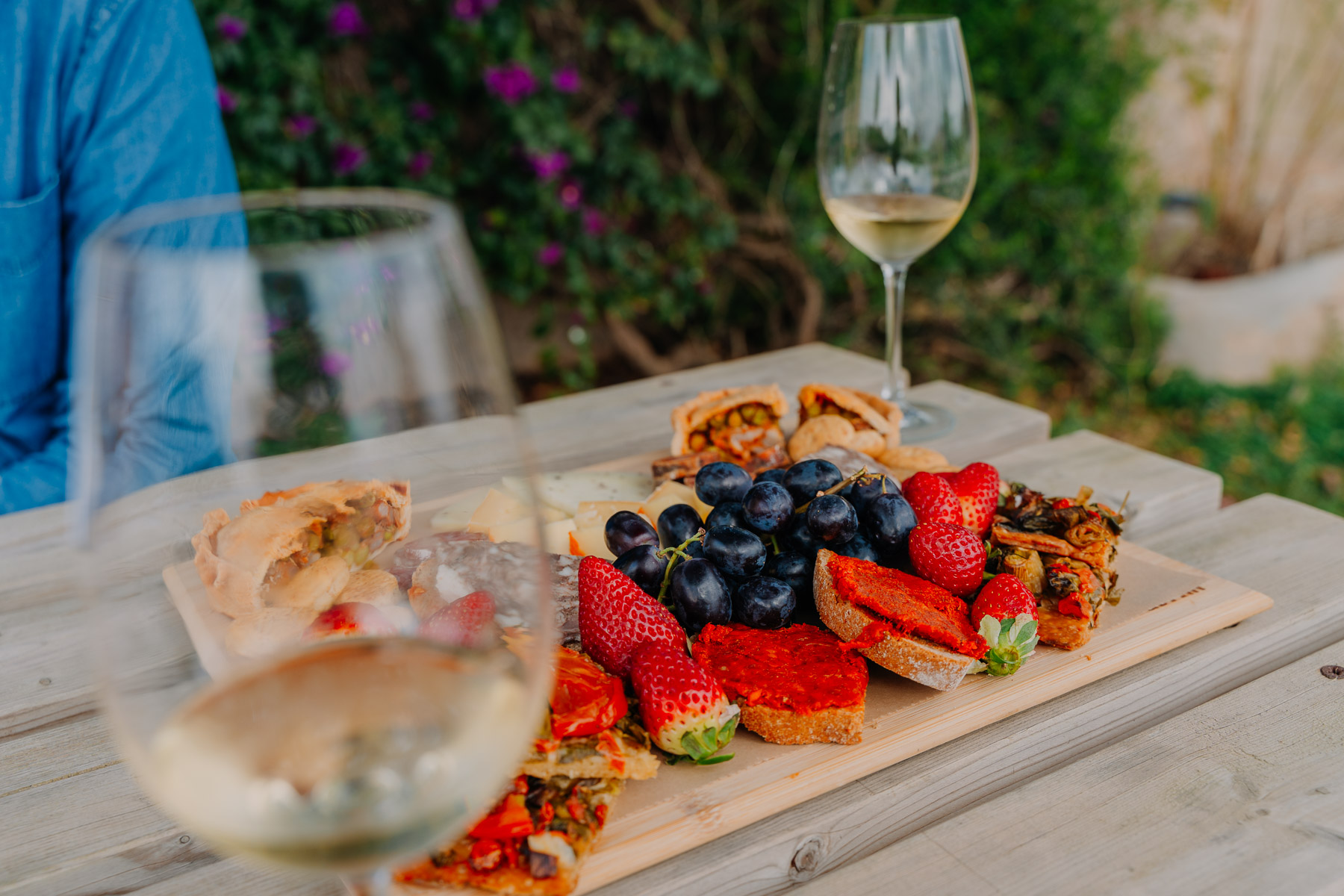
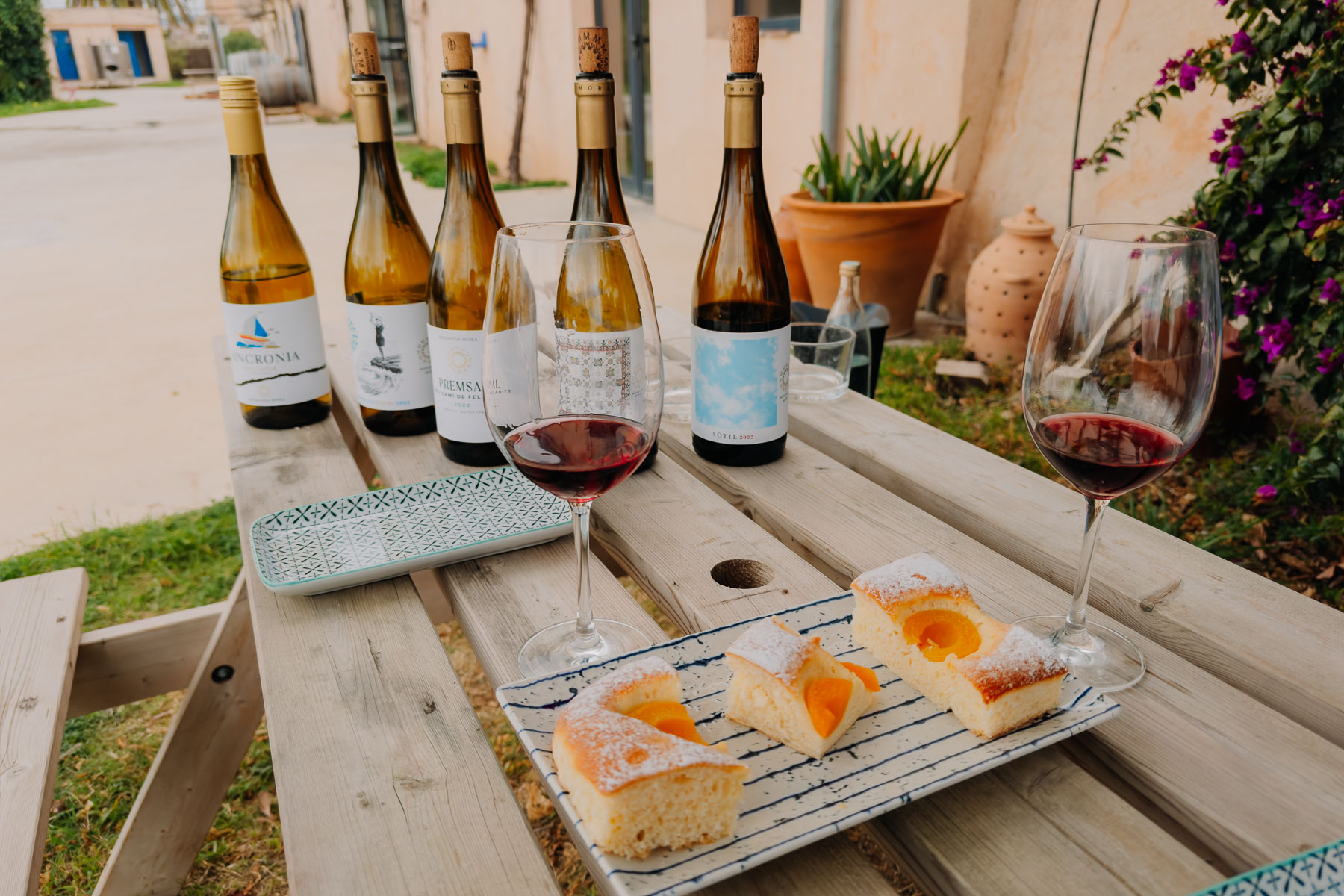
The tasting is the highlight of our visit. As it is a beautiful day, we will do it outside, at a wooden table, which uses a vine as an umbrella to protect us from the sun. Before the first of the bottles we are going to taste, Bàrbara brings us a wooden table, full of food to accompany the pairing: panades, grapes, strawberries, Quelys, bread with camaïot and sobrasada, among other delicacies.
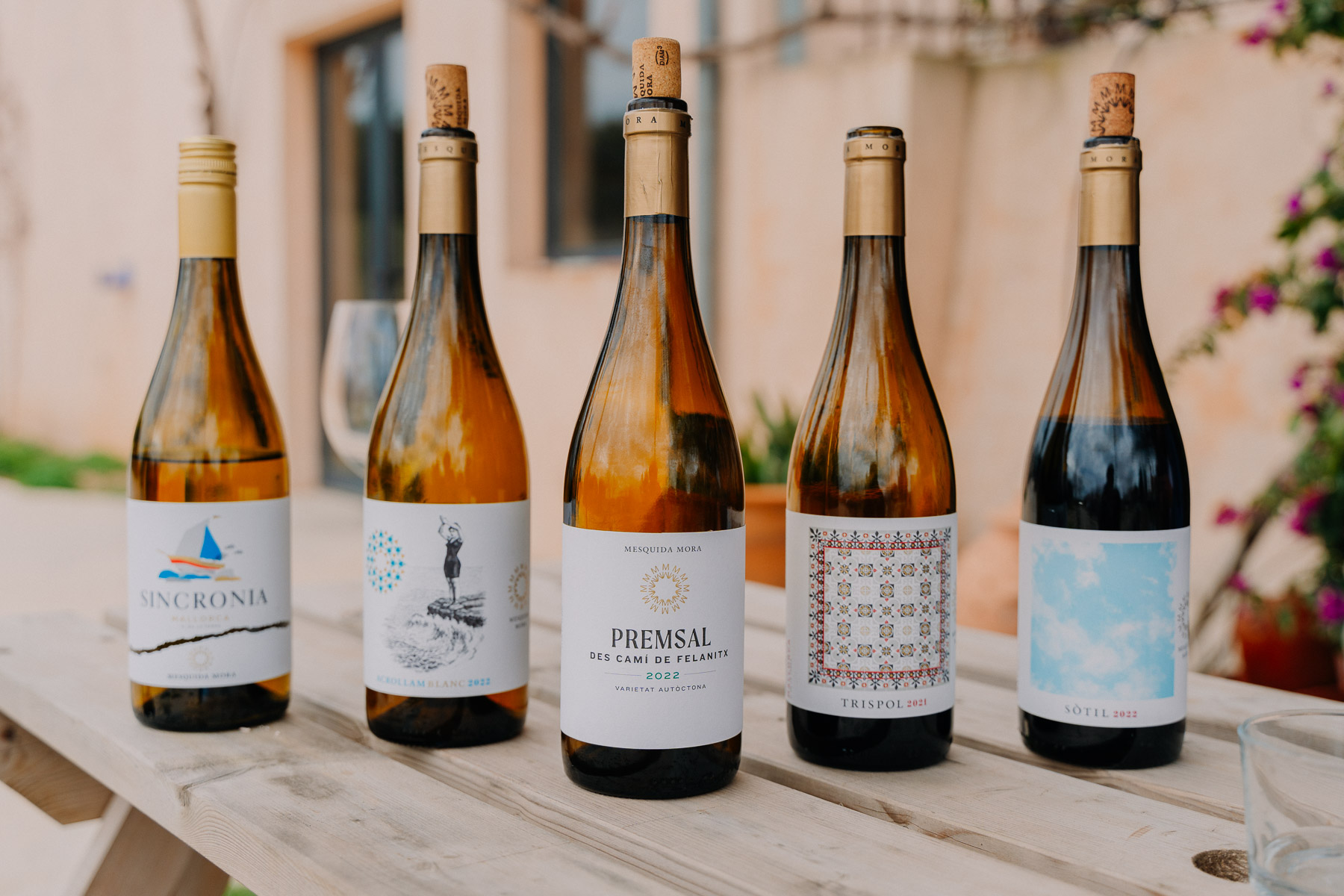
We start with Sincronía white, the number one seller of their whites. A perfect blend of premsal and giró from young vines and a blend of chardonnay. With fruity notes, it is a smooth and light wine, with a dense but fresh finish. The second wine is Acrollam, another white, but in this case fifty percent premsal variety (obtained from 3 different processes: carbonic maceration, fermentation with skins and direct pressing) and another fifty percent giró variety (in this case, this variety grafted on merlot vines). Here we find a deeper, more gastronomic flavor, with a saline touch.
The third of the whites is Premsal des camí de Felanitx. Hundred percent premsal, planted on red clay, close to where we are, between Porreres and Felanitx. Of simple elaboration, (directly pressed, with very low amount of sulfites) it is a delicate, fine and light wine. The reds enter the scene: Sòtil and Trispol. Trispol (2021) is composed of 3 varieties: callet, syrah and cabernet. The latter will be replaced by gorgollasa, as there is hardly any cabernet left. It is a light, tasty and full-bodied wine. And finally, Sòtil. Made entirely with callet, it is more flowery, ethereal, finer.
This is how we put an end to our visit and wine tasting at Mesquida Mora, but not before buying a bottle of white Sincronía and thanking Bàrbara for all the time she has dedicated to us in this experience that we hope to do again.
Suggested options