It all started out of veneration for horses, an attachment that the Eisenmanns wanted to transfer to Mallorca because love knows no countries or borders. This Swiss-German family owns a leading supplier of industrial solutions, a business facet that they combine with the adoration they feel for these animals. At the turn of the century, the couple began their search for a property where they could breed various Hanoverian animals. It was then when they came across the Es Fangar estate, an old building on the border between Manacor and Felanitx with an extension of 1,000 hectares, much more than they expected to find. "They fell in love with it. They bought it in 2002 to restore it and turn it into a world-class biofarm". This is what Carla Adrover, sommelier and commercial manager of Es Fangar Vins, tells us. "They immediately saw that the estate had a lot of history, with an oil mill and an old winery". The discovery of this winery was a revelation, a starting point that they had not planned. Peter Eisenmann then set himself a challenge: to recover the cultivation of vineyards that had been condemned to oblivion. An ambitious goal.
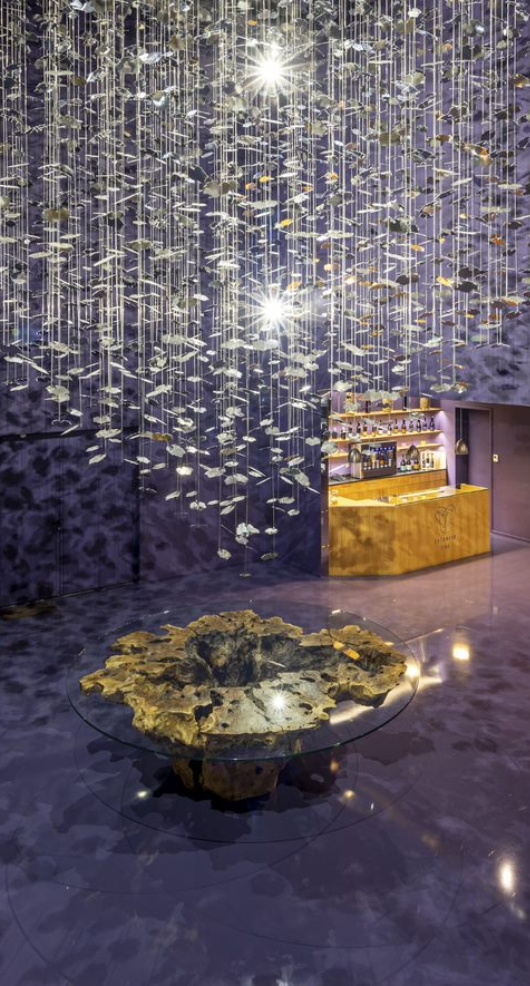
It is estimated that the investment that they designated to the production of their own wine amounts to eight million euros. A fortune that set in motion the necessary gears to get their project off the ground. "In the winter from 2004 to 2005 we worked with the first plantings of cabernet sauvignon. Then in 2009 the first wine was produced and the following year the winery as such was founded. We are quite young". A youthfulness that can be appreciated in the facilities to which we are invited, where technology is coupled with tradition in a symbiotic action. The entrance hall shouts at us the importance of design in this project, where a gigantic lamp pours a glittering rain on us, composed of vine leaves. The walls of the Es Fangar winery are painted in a provocative and meaningful lilac: the color of wine, a tone that brings peace.
When we ask about the vineyards, Carla tells us that they are a fifteen-minute drive away. "At first the winery was to be built where the estate is, in Son Prohens. But the Manacor town hall did not give permission because it is an anell, protected area. That is why the winery is here, in Felanitx". However, this is not the first winery in the project; the original one was built close to where we are now. But the natural growth of Es Fangar turned the tables. Between 2013 and 2016, twenty-two more hectares of vines were planted, an expansion that increased the total land devoted to vines to fifty-six hectares. It was in 2016 when the winery where our talk takes place was erected, a paragon of modernity and cutting-edge science that allows them to bottle one hundred and twenty thousand units a year, although the facilities have a much larger capacity: six hundred thousand. Even more if we contemplate the barrel room. Almost nothing.
"Our method is that of sustainable agriculture. All our wines are certified organic and vegan".
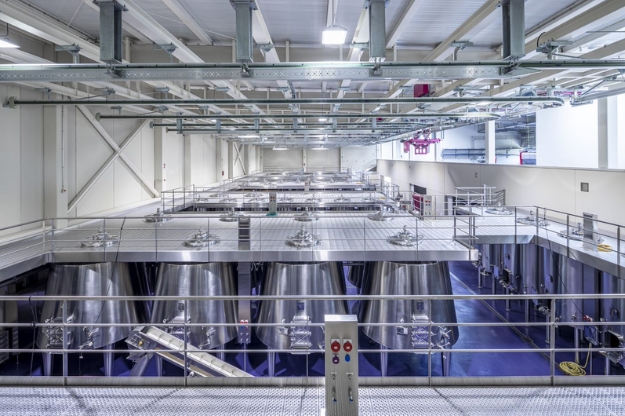
The figures may be high, but at Es Fangar Vins they have their feet on the ground. In vineyards that grant them the autochthonous varieties they work with: giró ros, prensal blanc, manto negro, callet and gorgollassa. A local offer that they combine with some international proposals such as cabernet sauvignon, merlot syrah, chardonnay or muscatel. "Many people ask us if we want to plant more. The answer is yes, but for the moment we are focusing on what we have, which is already a lot." Focusing on what they have, as Carla says, represents focusing their passion on the eight wines that make up their catalog, to which we must add a limited edition they have just launched. When we took a tour of the winery, we were impressed by its size and the more than sixty tanks that populate it. An infrastructure where the harvested grapes are cared for with meticulous care.
When they decided to carry out their project, the Eisenmanns had in mind a philosophy that has become the cornerstone of Bodega Es Fangar: to work in harmony with nature to create products of the highest quality. "Our method is that of sustainable agriculture. All our wines are certified organic and vegan". Merits that translate into the absence of chemical fertilizers, the production of their own compost and a commitment to green cover crops or green manures. "The most common plants we use to fertilize the rows in the vineyard are mustard and field beans. The mustard acts as a pesticide and the field bean creates little balls of natural nitrogen in the roots". An organic procedure that is finished off with the actual task of harvesting the grapes, carried out by hand by a team that travels through the estate's domains by bicycle. A true commitment to the environment.
"Thanks to this mechanism, we obtain a much less oxygenated wine".
The elixir they extract from the grapes is not only associated with the respect they give to nature, as technology plays a more than relevant role in Es Fangar Vins. We look at a plate hooked on the roof of the warehouse and that moves along rails at a great height. Cristina Madrid, the winemaker of this winery, explains that it is the gravity system. A machinery that provides undeniable advantages: "This method allows us to release the grapes in a tank without having to pump them. The pump emits impulses from the oxygen, and oxygen is an enemy of wine because what it does is oxidize. Thanks to this mechanism, we obtain a much less oxygenated wine. The word of an oenologist. Expert's word. "It is not usual to have this system".
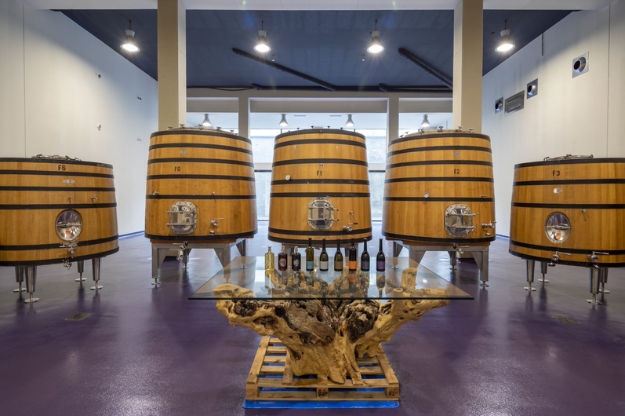
Before ending our visit, Carla and Cristina invite us to taste some wines. Between the purple of the walls and under the light of a store where their products can be purchased, they serve us a white Twenty Twelve made with muscatel. A sip makes us fall into an aromatic liquid with fruity notes that still lives in our memory. Unlike the cloying sweetness of other muscatels, this one is wonderfully dry. Then it is the turn of Sa Sivina, another white that advocates local varieties and of which they say they are very proud. Between ten and twenty percent of this grape is matured in new French oak barrels for four months; the rest of the time it remains in stainless steel. Intense and explosive flavor that enters with unctuousness. Finally, we are given to taste a red whose grapes go through an individualized, manual cleaning process. This is a limited edition Fangar-Genesis. A wine that tastes light, fruity, and that has not been in oak barrels. A special and perfect drink for a farewell that will not be definitive.