"Your name, oh sea! resounds within me; it awakens my tired fantasy: it moves, it magnifies my soul, it fills it with fervent enthusiasm [...]" The Mexican poet Guillermo Prieto wrote about the sea in the 19th century. Occupying about 70% of the total land surface, with a wide palette of shades of blue and a vast diversity of living beings that inhabit them, it is understandable that throughout history it has been a source of inspiration for many. But unfortunately, and for some years now, it has also been a major concern for many of us. Increasingly punished by the direct action of people, this diversity and colors are slowly fading.
It is everyone's job to fix this situation or at least contribute as much as we can to raise awareness of the importance of conserving our seas. One of these awareness projects can be found on our island, in the hands of María, and she does it through jewelry and her project: Coralviu. But before we dive into this project and tell you about her work, let us introduce you to the people behind it all.
María Mantecón has been in love with the sea since she was a child. Proof of this is that while she was studying law, in order to earn some extra money, she worked as a swimming teacher having studied and obtained a diving certificate years before. The degree, at that time, was becoming very difficult for her. In spite of everything, she finished her studies and decided to take a competitive examination. But she was soon plagued by doubts and not so sure about her degree any more.
After some time locked up studying, she decided to look for something that would help her escape a little from the daily routine. It was her sister who, after taking the course, recommended a place: S'Estellera Escuela de Joyería. She went 1 day a week, about 3 hours. She began to make her own jewelry. Some of those first pieces were made of shells, stones from Santa Lucia. But she felt she was doing something wrong. "What was the need to take something out of the sea to make jewelry? There had to be another way."
"I wanted to make jewelry that conveyed a message: marine conservation".
It was at that time that she met Fernando, a diver and underwater photographer. He has been passionate about the sea, the depths and its protection since he was a child. Together, they began to sketch and take the first steps in their project. Maria had it clear from the beginning: "I wanted to make jewelry that conveyed a message: marine conservation".
At first she thought of making it with recycled plastic collected from the sea. But Fernando wasn't sure, he thought the result would be pretty bad. They kept thinking about it, until one day, he remembered that he met a guy who at that time lived in Japan and was dedicated to making *photogrammetry of the seabed. They tried to contact this person, but it was impossible. Far from giving up, Fernando, a curious, restless and determined person, began to gather information about photogrammetry.
They got down to work: they bought a 3D printer and all the necessary materials for casting and thus had their own workshop at home. In the beginning they had the help of a boy who knew how the printer worked, until Fernando learnt how to do it on his own. Then their first collections started coming: Gorgonia roja, Coralina and Cayume. When everything was ready to launch Coralviu, something tragic happened. Fernando, in one of his dives, was not able to go back to the surface and sadly lost his life.
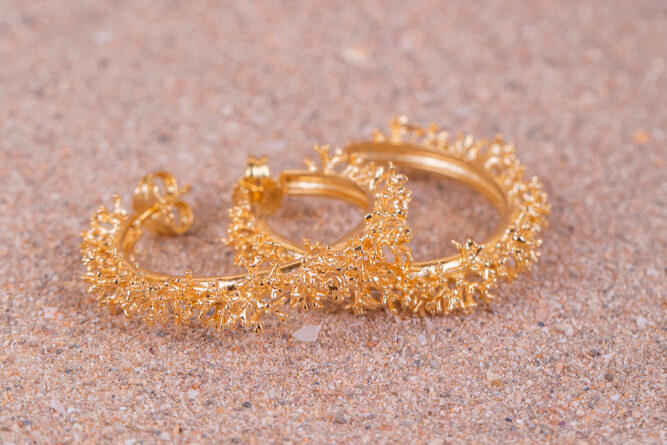
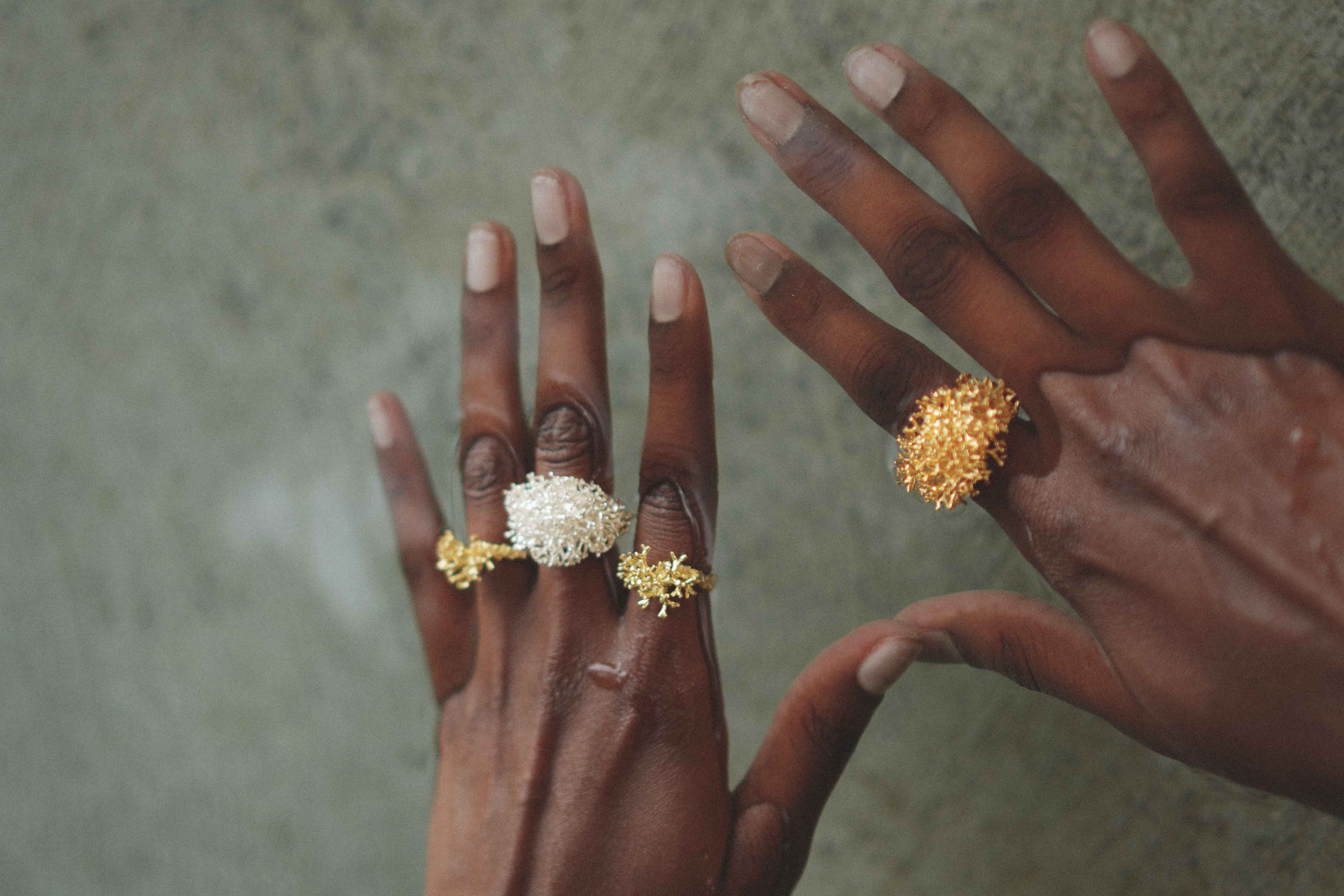
"You don't have to pull something out of the sea to make it look beautiful".
At that moment everything was left on standby. During the grieving process, and after 3 months stopped and not really knowing if she was going to continue, she made the decision to, at least, make the brand known and everything they had elaborated up to that moment. "We had done so much work that the project and us deserved to be out in the world". Besides, it would help her move forward and have something to fight for, it would give her that extra push she needed.
At the beginning, she started up again with the help of her friends, who, as well as they could, helped her in different parts of the elaboration process. But this only made everything slower. The process of making a piece is very laborious. Luckily, Maria would soon find a person who could help her with everything. They managed to launch the collections and it turned out to be a great success. First among family and friends, and little by little, people began to discover the project. Today, she has orders coming from all over the world (from the British Virgin Islands to Chile), and people like Malena Costa, Silvia Alonso or Gador Muntaner, wear her jewelry.
Despite her success, she remains clear about her primary purpose: to raise awareness about the protection of the seas. "You don't have to pull something out of the sea to make it look beautiful," she reminds us. And she takes care of every detail. When we place an order and receive one of her pieces, they come in a wrapping made from recycled boat sails and a button made from plastic found in the sea. In addition, a card gives information about the living being in which it is inspired and a photo.
In addition to raising awareness through her jewelry and her project, she collaborates with the Hombre y Territorio Association, which is currently carrying out the MedCoral program, the first one dedicated at a national level to learn about, conserve and protect corals. Because if something is clear to us after chatting with her, it is that everyone, without excuses, to a greater or lesser extent, can contribute to the improvement of our seas and, therefore, the planet earth.
* Photogrammetry: This is a technique that allows us to obtain reliable data of real world objects in the environment by creating 3D models from photographs. The 2D and 3D data are extracted from an image and, with superimposed photos of an object, building or terrain, are converted into a 3D digital model. This makes it possible to capture large objects, even landscapes, that would otherwise be impossible to scan.