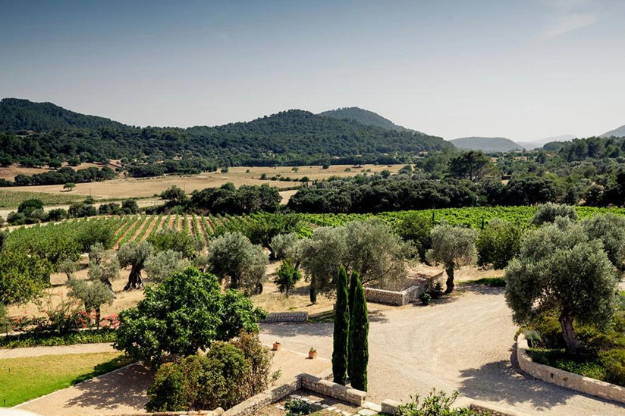
Following the zigzag of an old asphalt road that winds through the outskirts of Pollença, we reach the Can Axartell estate. Although from the barriers of the property we can only see fields, as we start uphill, we soon come across a building that leaves us speechless with its impressive glass facade: it is the Can Axartell winery, an imposing glass building that breathes modernity on all four sides, but that, at the same time, manages to integrate perfectly into its spectacular surroundings.
As we soon discovered, the building is the work of several architects, engineers and oenologists who put their knowledge at the service of the winery to meet three fundamental objectives: first, to harmonize the new winery in a protected environment -the Serra de Tramuntana, a UNESCO heritage site-; second, to make the production of wine following the gravity method possible and, finally, but perhaps the main axis of the project, to respect the landscape, the centenary olive trees, the different grape varieties and, of course, the people involved in the whole process. With this three-pronged approach, it comes as no surprise that the motto that sums up the philosophy of this unique winery goes like this: The best wine is obtained with respect.
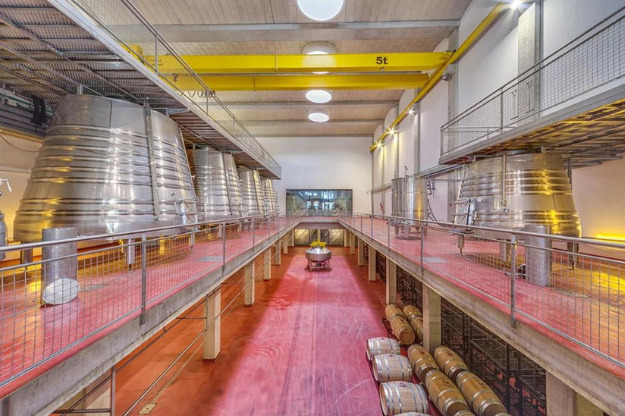
Undoubtedly, the gravity method is one of the particularities of Can Axartell that attracts the attention of those who visit the winery in their guided experiences. However, this is actually a winemaking system with a long history. Its main advantage is that it makes it possible to dispense with pumping and friction of the wine during fermentation in order to preserve each and every one of the aromatic subtleties of the different grape varieties.
Although this method, which works the grapes gently, is actually ancient, very few wineries in Mallorca still use it. Maybe, perhaps, it is because of the challenges involved: a lot of technological investment and an infrastructure adapted to the system, two challenges that Can Axartell was able to solve very well by constructing a four-story building expressly designed to make gravity vinification possible. But that was not all. In addition, by locating the building inside an old and impressive quarry, they opted for energy efficiency, since thanks to this location they are able to maintain the ideal temperature of the winery in a natural way.
"We are committed to the recovery of native varieties because we want to preserve what we have."
The project was undoubtedly challenging and complex, but Hans-Peter Schwarzkopf and his family wanted to bet everything on it. At the time there was a lot of work to be done, as the various buildings, the olive grove and the vineyards were in very poor condition, so the first unavoidable task was to reclaim the land. They got down to work and in 1999, three years later, they planted the first vineyard, following the guidelines of organic viticulture. Today, almost three decades later, the vineyards already occupy sixty hectares between the Pollença estate and Na Boscana, another of the family's lands located near the municipality of Villafranca.
From the first harvest until today, the growth of Can Axartell is unquestionable. The grape varieties harvested are national -callet, giró gros, manto negro and prensal-, Mediterranean -such as the Malvasia grape from Banyalbufar, monastrell and syrah- and international -such as pinot noir and petit verdot-. To this extensive list must be added the traditional varieties grown in the winery's experimental vineyard. These are varieties that had disappeared (or were about to disappear) after phylloxera and that Can Axartell has proposed to study and recover, in an exercise of biodiversity conservation, such as vinater negre and blanc, mandó, quigat, argamussa, giró negre and esperó de gall, among others.
In addition to this experimental project, Can Axartell collaborates with the Conselleria de Cultura and the Universitat de les Illes Balears in a project located in Sa Granja that aims to sanitize the viruses and study the DNA of these disappeared local varieties and see the possibilities of their recovery. "We are committed to the recovery of native varieties because we want to conserve what we have," they tell us.
"If one year we don't find enough quality to make a wine, we simply don't make it."
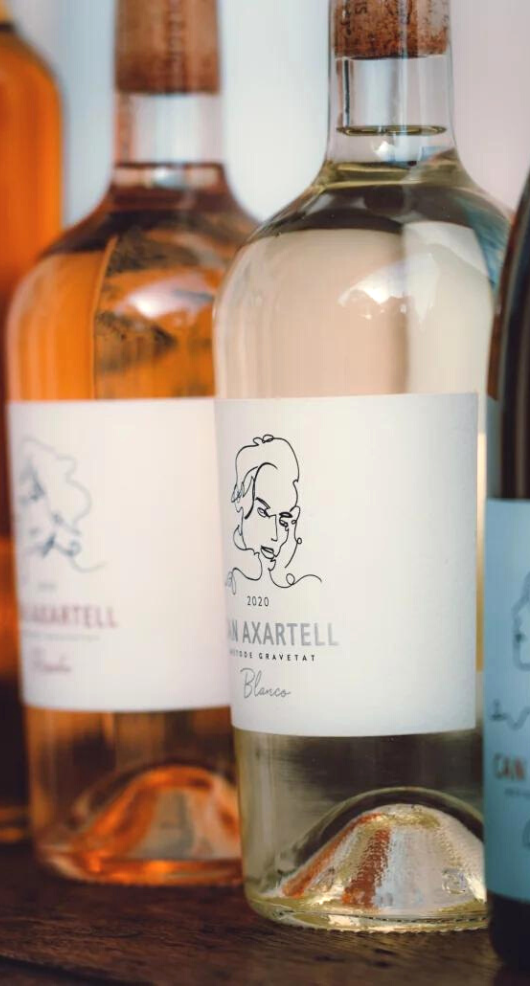
The growth of the winery is also reflected in its numbers: in 2022 they produced 250,000 bottles, the permanent team now numbers 23 employees throughout the year (and 40 at harvest time) and its portfolio of wines has diversified over the years into three ranges. Each of these has its own personality and idiosyncrasies: the everyday wines express the freshness of Mallorcan wine, the gastronomic line is complex, deep and aged in wooden barrels, and finally, there are the limited edition wines, which are produced only when a variety stands out for its quality. And in that they are extremely strict, as they explain to us while we walk through the winery, "if one year we do not find enough quality to make a wine, we simply do not make it. For example, in 2020 we did not produce Terrum, one of our most outstanding wines because we did not achieve the quality standard we were looking for".
At this point, about to say goodbye in the hall while admiring the Serra landscape, this determination no longer surprises us. On the contrary, it confirms what we had suspected since we arrived at Can Axartell: here every decision is carefully studied and taken conscientiously, nothing is left to chance because what always prevails is respect and quality.