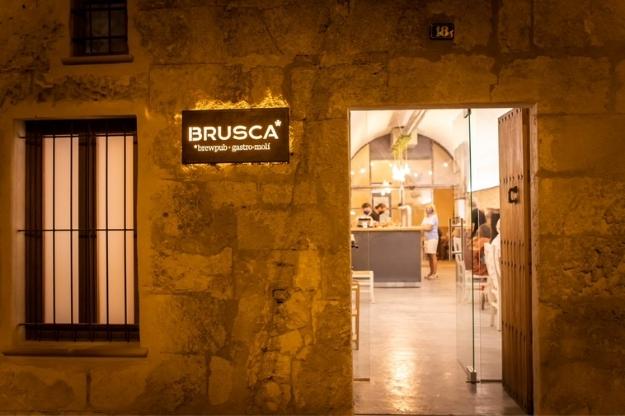
Records show that the chronology of Molí de Sa Torre dates back to the 18th century, a time when Mallorca subsisted thanks to the work that peasants and farmers carried out in the countryside. Agriculture was the most exploited source of wealth in a century that was not easy for the humble people. Pirates sailing the Mediterranean, weather conditions of complex prediction. A bad harvest could dash the hopes of entire families. Surviving was not an easy thing, but this flour windmill withstood the onslaught of time until today. It was Neus Llopis and Miquel Gelabert who one day, after almost a year of looking for premises, saw a for sale sign on a building with cracked walls and a cracked floor. "It was completely abandoned, in ruins. But we immediately saw that it had a lot of potential. We thought it was a cool idea to give a second use to a historic building where cereal used to be processed." Miquel serves us at the bar of Brusca, the brewpub that has breathed life into this old mill that today, three hundred years later, looks like another one. "We bought it at the end of 2017. We jumped in headfirst."
The project was not without risk. Setting up a craft beer microbrewery in the heart of Manacor brings courage and knowledge, two incentives that Miquel and Neus have been sowing since they met at the Universitat Rovira i Virgili, in Tarragona. Both studied Biotechnology, and while he decided to turn towards the world of Oenology - his family owns the winery Vins Miquel Gelabert -, she preferred to take other branches: Master in Advanced Microbiology and another in Fermented Beverages with a specialty in Brewing Science and Technology, which is soon to be said. Tied up with the shooter because customers are arriving, Neus approaches us to tell us that they started making beer at home because "it was fun, but we never thought of it as a business. When I started my master's degree, I realized that everything we had studied in Biotechnology was also in beer".
In Mallorcan, we say pegar una brusca when someone makes a sudden decision, without warning, and is taken by something that was not on their agenda before. What happened to this couple, however, was more than premeditated. Neus' professionalization paved the way for a project that, for the last year and a half, they have been undertaking with common sense and love for the land they walk on. A native land for Miquel and an adoptive land for Neus, Valencian by birth. For both of them, Brusca Brewpub is the culmination of a dream for which they bet everything. If they bought the mill at the end of 2017, the reforms could not start until February 2020, a month before the confinement. Work resumed in September of the same year and finished in July 2021. Bureaucratic red tape and the ravages of the pandemic made it difficult to begin.
"We made a very large investment, but this installation allows us to have the whole process controlled".
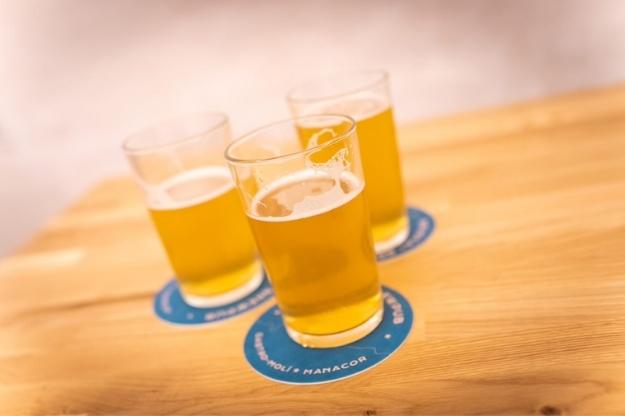
While Miquel tells us about his odyssey, our attention is divided between two elements that are the main attraction of Brusca: the undisputed quality of its beer and the architectural aesthetics of the mill. We taste a Blanche with notes of coriander and a hint of citrus, given by the peel of the oranges that grow on the trees planted in Sa Vall. We plunge into the golden pallor of the beer and Miquel, from the other side of the bar, explains that "we have a collaboration with Terragust that consists of brewing some of our beers with their products, whether fruit or aromatic herbs. It's like an agreement of maximum proximity, because we are right next door". Neus and Miquel have always been interested in the transparency of what they consume; a very internalized concern that harmonizes with a high level of demand. The seven beers that complete their catalog - the list is renewed every time their product runs out of stock - meet standards of excellence that they set for themselves.
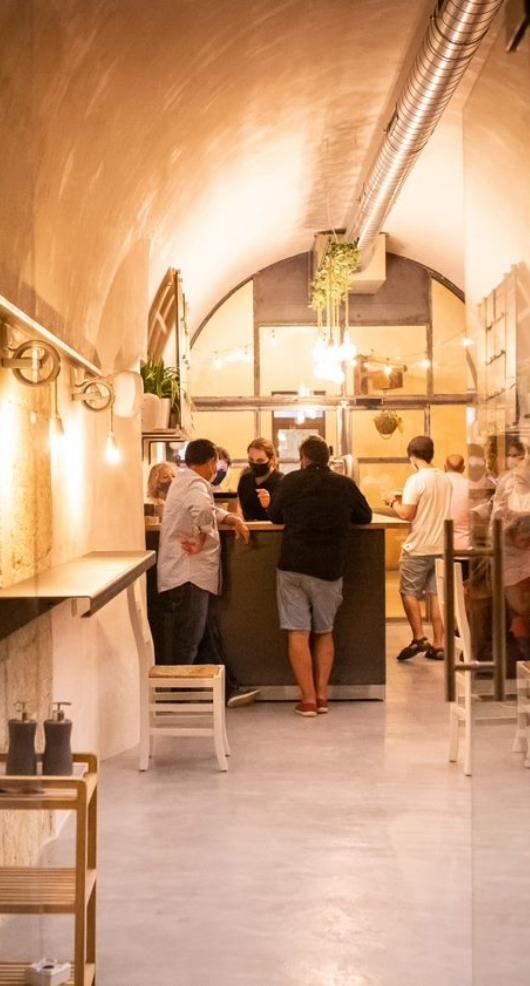
Encouraged by the Blanche, we ordered a Helles that slid down our throats smoothly, a German-style lager that won a bronze medal at the last edition of the CICA. One of Brusca's secrets lies in its refreshing temperature. Once the fermentation and stabilization process is finished, the liquid cannot exceed five degrees. "We have a 40-square-meter subway cistern under the patio. There we have a chamber where we store all the beer, which is connected directly to the bar. We made a very large investment, but this installation allows us to have the whole process controlled." When Miquel and Neus took over the mill, they didn't know about the existence of this cistern, which is accessed through a trapdoor leading to a spiral staircase. Miquel invites us to go down, and we feel like we are in a secret grotto of a Trappist monastery. The space is overwhelming. "When we found it, it was all covered by a meter of mud. We shoveled it out with wheelbarrows thanks to the help of two masons". The chamber is a work of engineering that the two of them put together. How did they do it? They learned as they went along.
"We eliminate labels, caps and bottles so as not to create waste".
In the darkness of this cellar, which they did not expect to discover, lie a few wineskins tightly pressed against the wall. They all preserve different fragrances and flavors. Miquel unscrews the cork of one of them. Through a tiny hole we can glimpse a few pieces of fruit floating in an acidic base: strawberries, apricots and raspberries from Terracor. Inside another boot, there is a beer that has been aging for a year with a local grape variety: callet. Not everything is going to be beer at Brusca Brewpub, as the taste for wine that Miquel has inherited allows his menu to include products from his family cellar, some of which are hard to find.
We go up to the surface of the patio, which serves as a terrace. The afternoon begins to wane and the tower of the mill is silhouetted against the sky. A group of people seated at some tables chatting absentmindedly. It seems that they all know each other. An eminently Manacorí public that engages in conversation between gulps of IPAs and Ambers, located near the space destined to the microfactory. The absence of an element inseparable from the beer catches our attention: there are no bottles. "We eliminate labels, caps and bottles so as not to create waste. Here we brew and sell directly. This lets us experiment, so we're not forced to stick with the same beer every time. It also frees us from competing with industrial prices". Before we leave, two friends at the bar shake our hands. Miquel explains to us that they have a hop plantation with more than two hundred plants, and that Brusca collaborates with them to brew beer from their genre. "We will soon bring out the 2022 harvest". We'll be on the lookout to taste it.