In the memories of many Mallorcans, there is the image of a table already set, adorned with the tablecloth of family banquets and the Duralex cutlery that never fails. In that postcard that we try to draw, paella is eaten, it is noticed by the aroma that comes from the kitchen, by the good mood that the grandparents give off and because the calendar indicates that we are in the seventh day of the week. We look at the radishes resting on a plate, at the white bell pepper so typical of here that, as a snack and raw, goes wonderfully well with rice. But it is not the paella still smoking over the fire that attracts all the attention; it is the bottle of pinya in the center of the table, presiding over the meal, which lets out a gaseous hiss as it unscrews its cap. That bottle is the one that passes from hand to hand, from glass to glass. And it was the Puig brand that enlivened so many home scenes like the one described in this paragraph, an integral part of a collective memory that today also speaks in the present.
"Anyone who has had a childhood in Mallorca and who is around my age remembers the pinya". Julià welcomes us at the Begudes Puig returnable packaging center, located on the edge of the Son Castelló industrial estate in Palma. Born in 1992 and great-grandson of the person who inaugurated this family project, he does not hide his emotion when he talks to us about the business trajectory that his ancestors inaugurated almost a century ago. "The people of Mallorca have an exceptional affection for the pinya. Every time I say I'm from Puig they let me know". Around us, we are watched over by boxes full of refreshments that tell a little piece of the history of our island. A story that touches on issues such as the survival of a local brand that respects the land and is not afraid of large corporations. Begudes Puig has been able to adapt to the times and then reinvent itself.
It all began with an adventurer named Julià Puig, the great-grandfather of the person who is narrating this chronicle and with whom he also shares his name. An enterprising man who, after leaving the shoe industry, immersed himself into the siphon business in Llucmajor. A change of course that he undertook from the garage of his own home, where these things usually happen. "On the mainland, people thought that sparkling water lacked something. That's why they started experimenting with different aromas." Almost a hundred years have passed since then. We go back to 1927, when the soft drink business went through the roof in Europe, although it would be more accurate to say that it inflated like a bubble.
"Globalization and the arrival of the big foreign brands changed everything."
The Old Continent seemed to be too small for Julià Puig, who a year after launching his own soft drink decided to sail the seas with his friend Gascó. They set sail for a trip to Central America, stopping in Cuba, where they discovered a diamond in the rough that would mark a turning point in the future of their project: the piñita. "They liked it very much and thought that here, in Mallorca, it could work very well. It was an immediate success. Since then, the pinya has earned the legitimate right to proclaim itself as a local symbol.
The irruption of Begudes Puig on the carbonated beverage scene was perceived as a breath of fresh air. A novelty in every sense of the word, since the population of that time was used to water and wine. The effervescence of a sweet liquid that lingered around in the throat providing a slight spiciness was the ultimate trend, an unusual product with amusing touches in the second decade of the twentieth century. However, Puig's arrival did not lack competition. The passing of the decades meant that Mallorca, throughout the seventies, was infested with companies producing soda, siphons and colas. There were 131 businesses in this sector. "The fever was much greater than on the mainland. That competition caused the consumption of soft drinks to increase, but globalization and the arrival of the big foreign brands changed everything."
Julià refers to the landing of corporate monsters such as Coca-Cola, which through a totally destructive market strategy made numerous family businesses disappear. The U.S. company promised huge profits in exchange for the small merchant to distribute and manufacture its soft drink; an offer that was detrimental to the local product, as if the artisan abandoned his own creation to favor the giant. David versus Goliath. When Coca-Cola built its own factory and dispensed with its local distributors, it was too late for the local brands to make a comeback.

"My grandfather always worked with returnable glass and could not conceive of any other way of working".
But Begudes Puig was able to survive the predator thanks to romantic efforts that spread from one generation to the next. "My grandfather was always clear about one thing: what was his could not be taken away from him. He never turned his back on his product. So what he did was to acquire the brands that were closing in Mallorca. But without destroying them, which is what multinationals do. He bought them to continue producing them. He kept their original name because he understood that people were fond of them". Julià's grandfather distributed Gum i Ramis in Felanitx, Segura in Porreres, El Molino in Algaida and La Peral in Palma. The finishing touch came at the end of the eighties when he bought the Miret brand, also widely known in the capital. Thanks to this protective business vision, the inhabitants of the villages could continue to be linked to these drinks, whose bubbles share the DNA of the population.
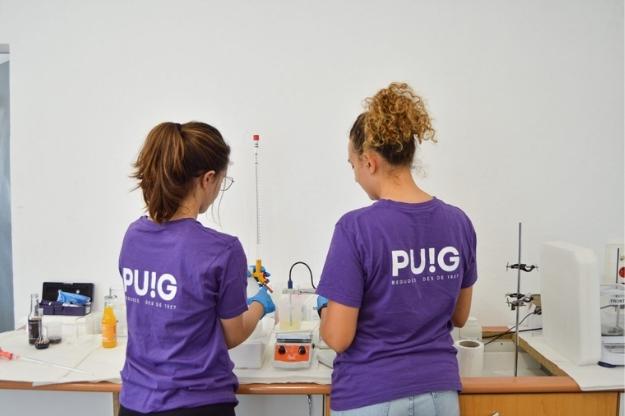
If Darwin said that it is not the strongest that survives, but the one that knows how to adapt better to change, Puig stands as the highest representative of this slogan. Ninety-five years after its birth, its catalog contains a colorful variety of products: pinya, lemonade, orangeade, cola, cola zero, lemon lime, tonic, ginger beer, seltzer and soda. A wide range that allows us to refresh ourselves with the essence of a native and sustainable product. "My grandfather always worked with returnable glass and could not conceive of any other way of working. He cried out against plastic, and my father continued with that philosophy". Puig's production process, therefore, does not support the use of plastics under any circumstances. The returnable packaging center they opened two years ago, where our talk is taking place, is a living example of this environmental commitment. A facility practically attached to their own factory, where they produce some 3 million units a year. These impressive figures are striking when we learn that the company had to close in 2004 for a year.
As if it were a plant, Puig has been regenerating itself since it reopened its doors. They started almost from scratch, making home deliveries to individuals in a van. Today they are once again present in bars, restaurants and supermarkets, with a staff that includes 50% of the employees coming from the Fundació Sant Joan de Déu and with future plans for next year, when they will start incorporating oranges and lemons from Mallorca for their juices. Puig is like a rejuvenated phoenix, as today it is making an impact on a young public that once again places its bottles at the center of the table, so that the happiness of yesterday is not just a thing of the past.