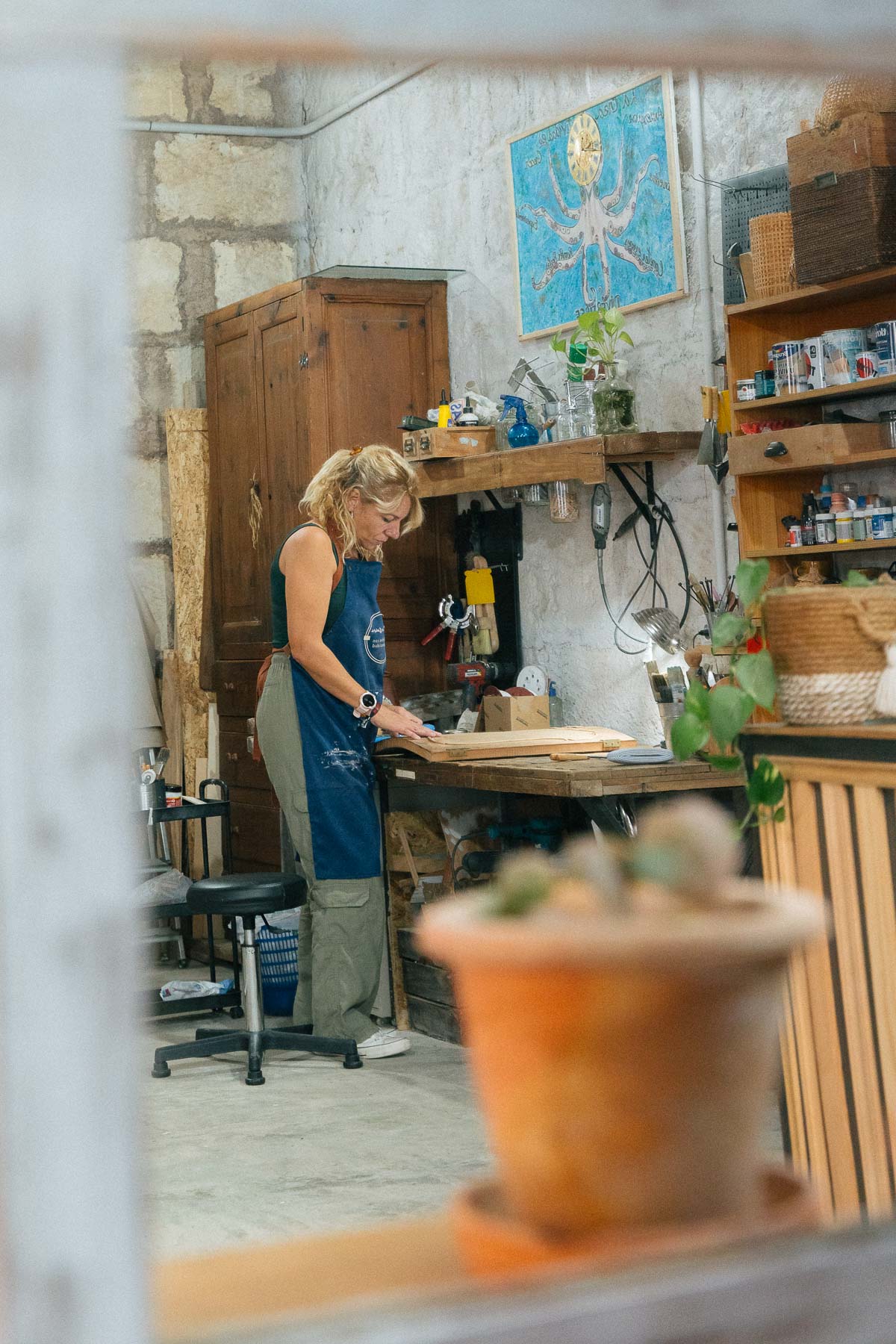
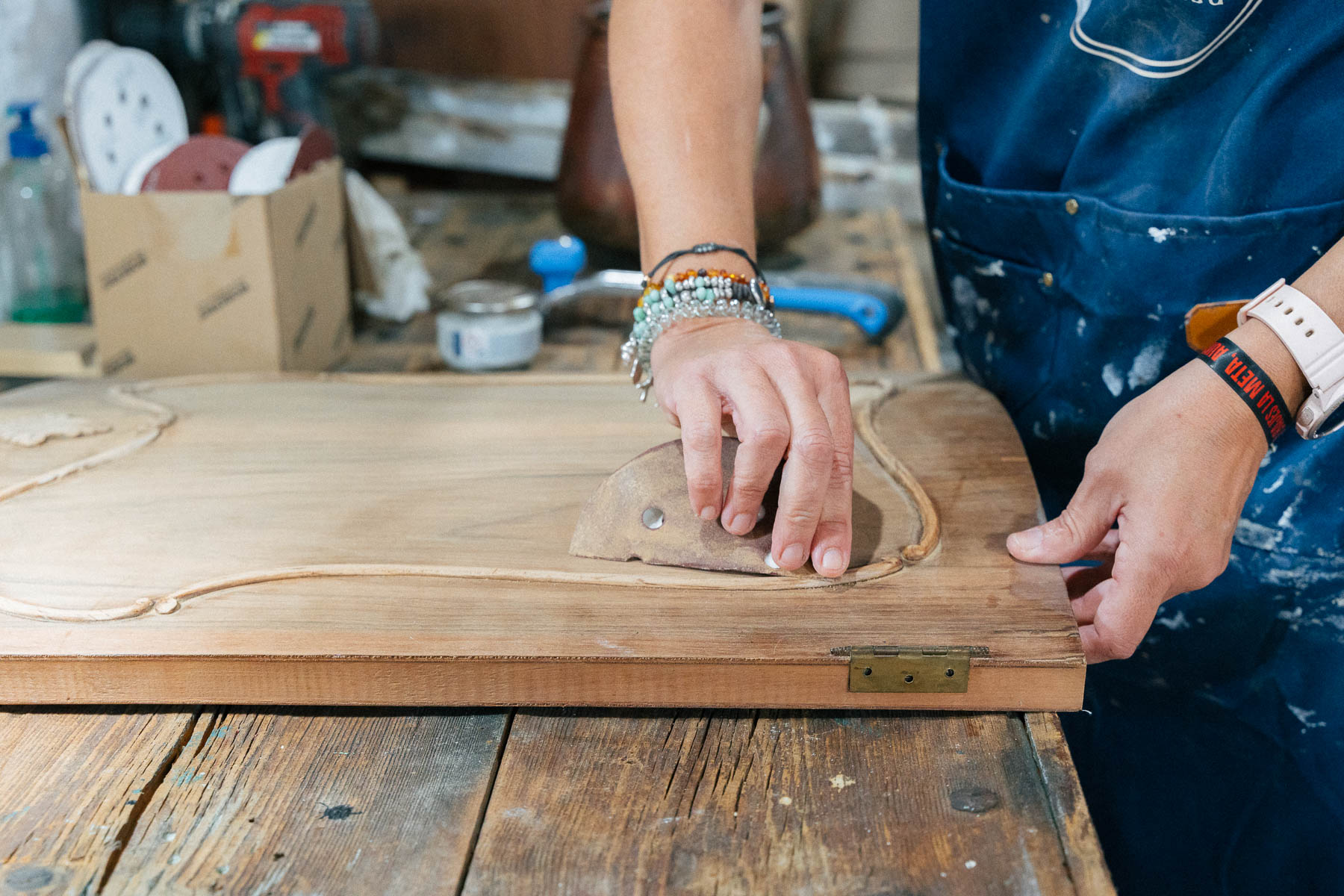
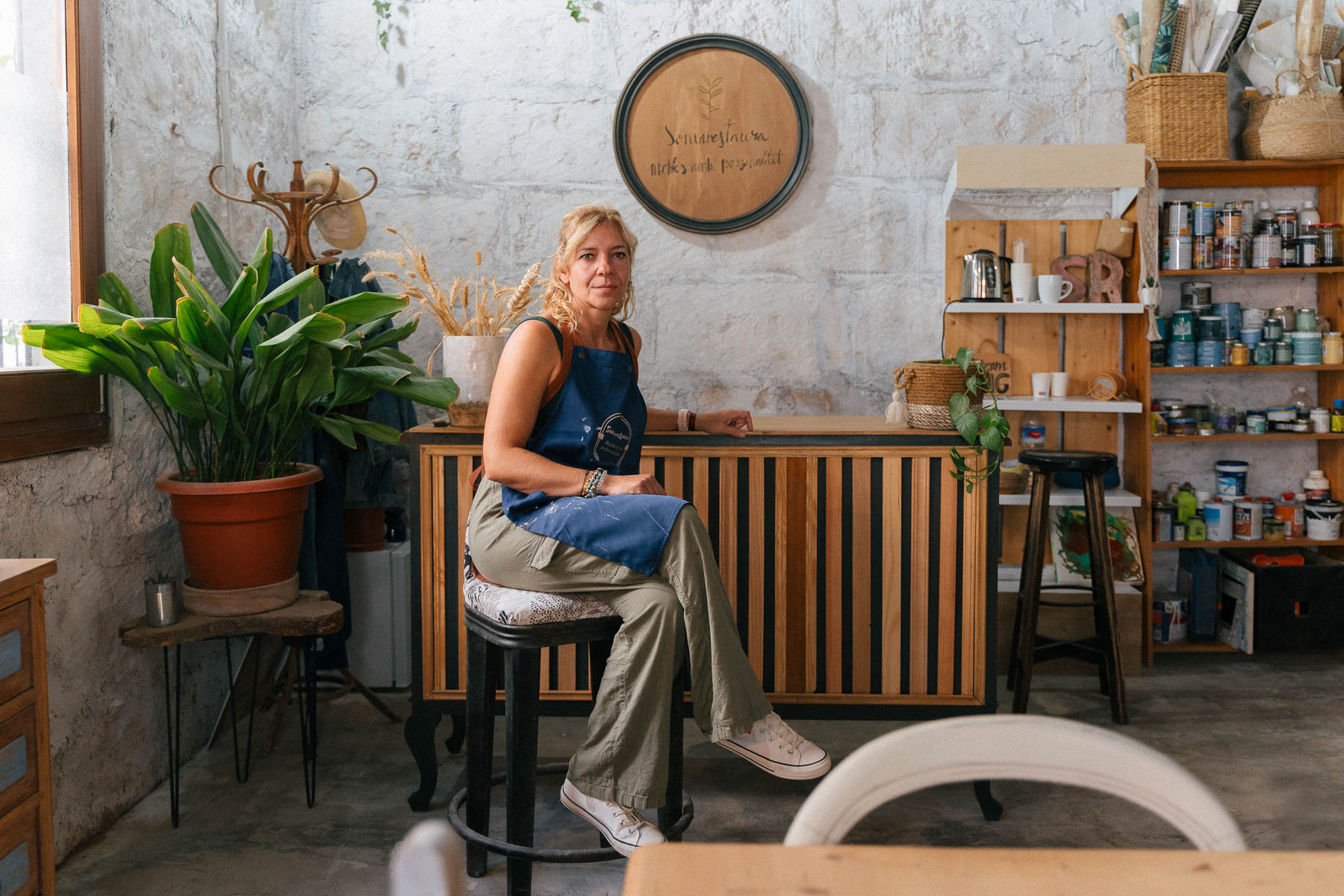
I grew up among workshops. My father was a mechanic and my grandfather was a pioneer in repairing radios and televisions, and I grew up in an environment where repairing things was part of everyday life. However, what always caught my attention the most was furniture. When people threw them away, I used to imagine who had previously owned them and where and what era they were from'. Dressed in a blue apron stained with varnish and paint, Sonia recalls, now with an adult look, a childhood spent among tools, pieces and second chances. A scenario that had a decisive influence on what is now her professional project: a furniture restoration workshop that focuses on sustainability.
When, a few years ago, she began to collect discarded furniture in containers, she says, 'I would give them a spin to bring them to the present time' and she immediately noticed that the people around her were actually curious about it. Motivated by the reaction of her surroundings, she began to restore pieces for family and friends in the time she was free at the end of her working day, until the day came when, faced with the impossibility of combining both projects, she decided to take the risk.
Since then, she has worked in different spaces and, after a period in a coworking in Sineu, at the beginning of 2024 she moved to Inca (in the central number 36 of carrer de n'Antoni Torrandell), where she restores furniture on her own and by order or, what is the same, she contributes to preserve their past and the emotions attached to them. This intangible value is, precisely, what she seeks to immortalize through a pampered and artisanal process. Any piece of furniture, even if it is more or less new, has had a history,' she says with conviction.
With this purpose, she elaborates a tailor-made proposal for each client -of a profile that she defines as very varied and that ranges from twenty to sixty-year olds, and live in both modern and rustic housing- and who she gets involved with during the whole restoration process. 'I have a lot of contact with them because they trust me. They are very happy because people are becoming more and more aware that we need to stop throwing things away and thus recycle'.
"Maybe they don't like a piece of furniture the way it is, but they give it a second life because there is a sentimental part in it, it is part of their family history".
Those who entrust their furniture to Sonia are, in her opinion, people who look far beyond, with an ecological vision, and people who have an emotional attachment to a piece of furniture and want to keep it. Maybe they don't like the way it is, but they give it a second life because there is a sentimental part there, it is part of their family history'. This is the point: to make furniture transcend time.
What happens from the moment her hands touch a piece for the first time until it is finished varies according to its condition, the desired result and the materials, but Sonia enjoys it, goes through it with pleasure and respects the timing 'because each piece of furniture is a world in itself'. So much that she even confesses with a shy smile that she finds it hard to put on the brakes and disconnect herself. I'm someone who, when I start something, I have to finish it, but sometimes I have to force myself to stop'.
A single glance at the furniture that occupies the spacious workshop is enough to understand that Sonia has the ability to adapt to her clients and meet their demands, but she also knows how to create something new and different through a 'very physical, but very comforting' work among wooden shelves full of varnish and paint pots, sandpaper and brushes.
"The workshops encourage them to disconnect from routine and connect with themselves and their own creativity".
The tranquility and solitude of Sonia's daily life in her workshop is altered -and with pleasure- on Saturdays, when she invites other craftswomen to give their workshops -of basketry, tapestry and even jewelry all created with sustainable materials-. Encounters that 'encourage them to disconnect from routine and connect with themselves and their own creativity. It's a way to focus on what you do and not think about anything else. People always repeat that time flies by'.
She also teaches her own weekly classes, flexible and by hourly vouchers, to students who want to transform a piece of furniture, a painting, a lamp or a mirror. Everything is welcome in this workshop that, in addition to preserving furniture, stimulates ingenuity: 'There are people who are eager to do something and have trouble visualizing the end, who don't know where to go' and discover that 'something they don't like can become something they love, a real treasure'.
Sonia defines herself as an ant, someone who goes 'little by little, but strongly. My steps are very slow, but continuous', she assures, while she affirms that her courage and the support of her family have been two fundamental factors in her journey, a path inspired by a triple will: to preserve the past of each piece of furniture, to recycle to make the world a little more sustainable and to contribute to make us all more conscious.
And that is precisely what she achieves. Pieces that you will not find anywhere else and that testify as many stories as emotions associated to them, but that at the same time remind us that it is in our hands to reduce the environmental impact we generate every time we buy something new instead of giving another life to what we already have. A second chance and so many more lives.